



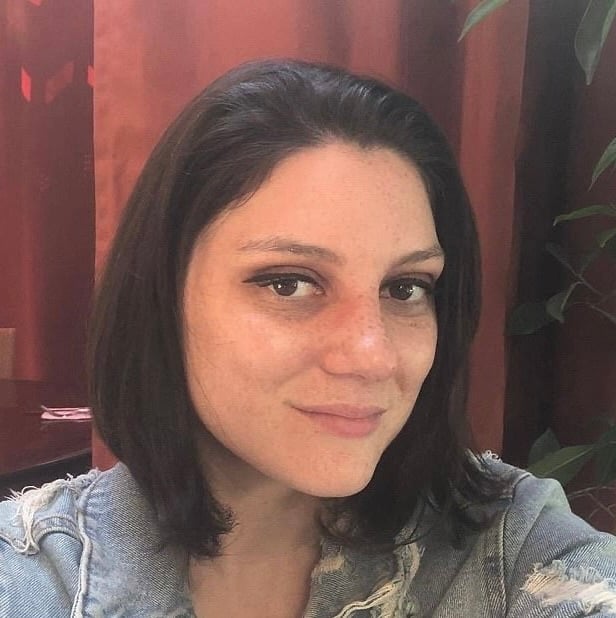
Weeks before a 34-year-old anti-gravity researcher was found dead from a gunshot wound to the head, she sent a retired British intelligence officer a message that has now resurfaced as part of a wider congressional inquiry into the deaths and disappearances of eleven prominent American scientists.
“If you see any report that I killed myself, I most definitely did not,” Amy Eskridge wrote to Franc Milburn on 13 May 2022. “If you see any report that I overdosed, I most definitely did not. If you see any report that I killed anyone else, I most definitely did not.”
Eskridge died in Huntsville, Alabama on 11 June 2022. Her death was ruled a suicide. Four years on, the messages she sent in the weeks before her death have placed her case at the centre of a growing political storm, with President Donald Trump and senior members of Congress demanding answers over whether a series of deaths in America’s advanced research community are connected.
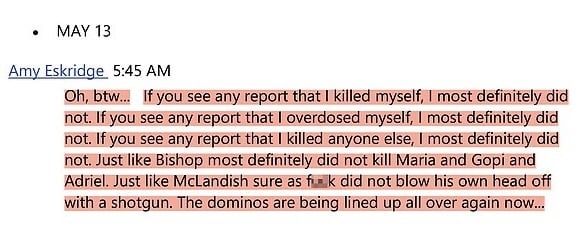
Milburn, a former British paratrooper and intelligence officer, told the Daily Mail he had spoken to Eskridge just four hours before her death and detected nothing unusual. He said she had sent similar warnings to multiple contacts — emails and LinkedIn messages instructing people that if anything happened to her, whether framed as suicide or an accident, it should be treated as suspicious. After her death, he launched his own investigation, driven in part by what he described as a deeply troubling timeline. “Why was she cremated so quickly? She phoned me four hours before she died, then she dies, then a few hours later she has an autopsy, and then on the Sunday, she’s cremated,” he said.
The claims Milburn has documented go considerably further than the messages alone. According to him, Eskridge had described a sustained campaign of harassment in the months before her death — break-ins at her apartment, cars following her, strangers approaching her in bars with intimate knowledge of her work, and repeated attempts to drug her drinks. On multiple occasions, she alleged, groups of between two and six people would enter a location shortly after she arrived, rotate through a seat beside her and ask the same questions in sequence, “as if they all read the same briefing materials,” she reportedly told Milburn in May 2022.
She also described what she believed to be physical attacks using a directed energy weapon — a device capable of emitting focused energy and causing burns. Milburn says she sent him photographs appearing to show burns and lesions on her hands, feet, neck and back. A former colleague with advanced weapons experience, she told Milburn, had examined both her injuries and a mark on her window and concluded the most likely instrument was an RF K-band emitter, operated from a nearby vehicle by a US-based contractor attempting to prevent her from completing government research.
Eskridge had founded her own research lab, co-established with her father Richard Eskridge — himself a former NASA scientist — called The Institute for Exotic Science, dedicated to anti-gravity technology and advanced propulsion. She had described creating the institute deliberately as a public-facing platform, having calculated that visibility offered a degree of protection. “If you stick your neck out in public, at least someone notices if your head gets chopped off,” she said in a 2020 podcast. “If you stick your neck out in private, they will bury you, they will burn down your house while you’re sleeping in your bed and it won’t even make the news.”
She had also received what Milburn described as anonymous messages encouraging her to take her own life, phrased as rhymes: “Take your pills and overdose and this will go away.” She told him she believed some of her former partners had been intelligence handlers, noting that relationships consistently ended and contact ceased after exactly six months.
Her father has disputed any suggestion of foul play. “Scientists die also, just like other people,” Richard Eskridge told NewsNation. The family described her in a statement as “a marvelously intelligent person” who had suffered from chronic pain.
Milburn brought his findings to a congressional hearing on Unidentified Anomalous Phenomena in 2023, presented in writing by journalist Michael Shellenberger alongside other accounts of alleged government retaliation against UAP whistleblowers. Milburn’s own private investigation concluded Eskridge had been murdered by a private aerospace company because of her involvement in UAP-related research. He has since issued his own pre-emptive statement: “I am not suicidal or contemplating suicide and if anything happens to me, it should be fully investigated as suspicious.”
Congressman Eric Burlison of Missouri confirmed that Shellenberger had briefed House members on the case and that lawmakers were now pushing for an FBI investigation into multiple deaths and disappearances across America’s scientific community.
