



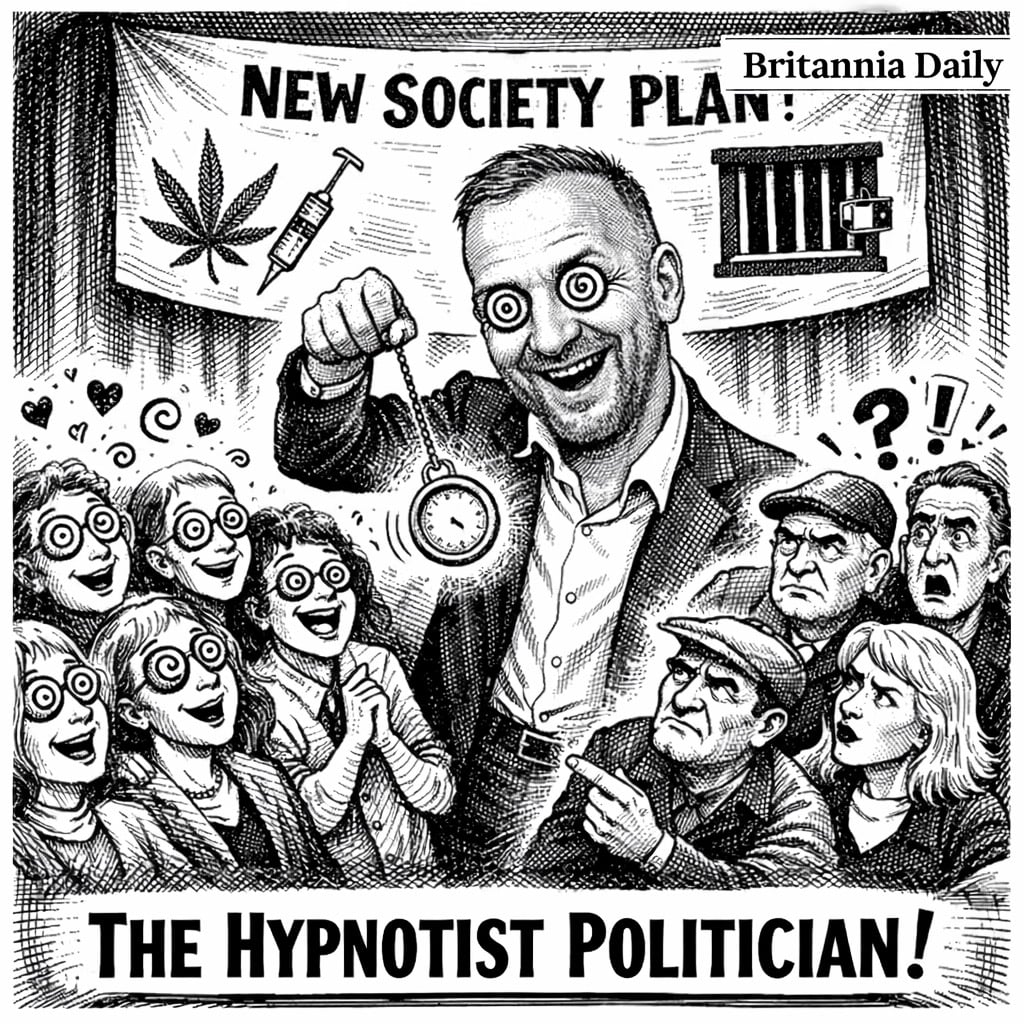
He wants to legalise every drug known to man, shut right-wingers out of society, and once claimed he could make women’s breasts grow larger through the power of hypnosis. Meet Zack Polanski — Green Party leader, self-styled political radical, and arguably the most colourful figure in British politics right now.
This week, Polanski added a new entry to his already extraordinary public record, questioning on his own podcast whether people with right-wing views should simply be excluded from the society he intends to build. For a man whose past includes charging women £222 a session for hypnotherapy breast enlargement treatments, it was, remarkably, not even the most eyebrow-raising thing attached to his name.
The Comments That Set Westminster Talking
Speaking on his Bold Politics podcast, Polanski asked broadcaster Zakia Sewell how communities could be brought together in an “increasingly divided” world — before promptly suggesting that one portion of that world might not be welcome at all.
“There are people who would identify as right-wing, or indeed even far-right,” he said, “and no matter what humanity or community we put them in, they are set on destroying or pushing this toxicity. Do we think we can change their minds? Or is it a case of building a society that doesn’t include them?”
His guest pushed back, questioning whether he risked “alienating people who are perhaps more moderate.” The response from the political mainstream was swift. Conservative Party chairman Kevin Hollinrake called the comments “authoritarian,” drawing a direct line between Polanski’s vision and the ideological frameworks of Soviet Russia, Mao’s China, and Castro’s Cuba. “This is the opening line of every authoritarian playbook,” Hollinrake said.
Reform UK’s spokesman was equally blunt. “Zack Polanski has just let the mask slip. He doesn’t believe in persuading people or winning arguments — he wants to build a society that excludes anyone who identifies as right of centre. That’s not politics, that’s authoritarianism.”
The remarks came at an already delicate moment for the Green Party, with several of its own local election candidates having faced accusations of anti-Semitic hate speech in the weeks prior. Polanski also used the occasion to challenge what he called the “predominant narrative” around Winston Churchill, describing the wartime Prime Minister as “deeply problematic.”
Legalise Everything, Abolish Prisons: The Green Policy Platform in Full
For those unfamiliar with the full breadth of Polanski’s political programme, his remarks on right-wingers are merely the latest chapter. Since becoming party leader, he has positioned the Greens firmly at the outermost edge of mainstream British political debate.
Speaking to BBC South East ahead of the party conference, Polanski confirmed he agreed with a Kent Green councillor who had called for the legalisation of all drugs, including Class A substances such as heroin and crack cocaine. “The war on drugs has absolutely failed,” he argued, “and ultimately we need to be having a public health approach.”
The policy extends well beyond cannabis. Polanski advocates for full legalisation and regulation of the entire drug market, removing supply from criminal networks entirely. Critics have noted the policy sits alongside separate calls from within the party’s grassroots for the abolition of prisons — one Green candidate in Scotland has called for prisons to be scrapped altogether — as well as the legalisation of prostitution.
Taken together, it is a political offer unlike anything being advanced by any other party with elected representation in Britain.
The Harley Street Years: When Polanski Made a Different Kind of Promise
Before any of this — before the Assembly seat, before the party leadership, before the podcast — there was the hypnotherapy clinic on Harley Street.
Polanski admitted to performing hypnotherapy sessions intended to enlarge women’s breasts, following an article by The Sun from 2013 resurfacing about him offering the practice. In the 90-minute sessions, allegedly costing £222, women were told to visualise themselves with bigger breasts.
When the story re-emerged during his political career, the handling of it did little to help. Polanski initially denied the allegation, claiming he had only tried it reluctantly “as an experiment,” before eventually conceding the point when pressed. He apologised, said the sessions did not represent him, and noted he had since led a rather varied life — including stints as a barman, waiter, nightclub doorman, and actor — before entering politics.
“This was 11 years ago. I wasn’t involved in politics at all,” he said, adding that he never charged for the service.
A Politician Like No Other — For Better or Worse
Whether Polanski represents the future of the British left or a cautionary tale about the dangers of ideological overreach depends entirely on who you ask. His supporters see a principled radical willing to say what others will not. His opponents see a man whose instinct, when confronted with disagreement, is not to persuade but to exclude.
What is beyond dispute is that British politics, rarely short of characters, has not seen quite anything like him before.
