



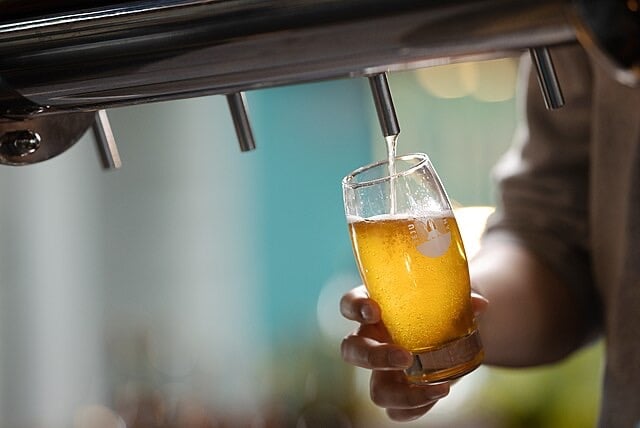
Britain’s pub trade is facing an anxious wait over the coming weeks as brewers warn that the ongoing conflict involving the United States and Iran could trigger a shortage of carbon dioxide — the gas that puts the fizz in draught beer — just as the World Cup gets under way.
CO2 is an essential component in carbonating drinks and dispensing beer through taps, and its supply has historically been vulnerable to disruption during periods of geopolitical instability. With the tournament beginning in under two months, industry figures are watching the situation closely and urging the Government to take action before any shortfall materialises.
Richard Bradbury, managing director of Theakston, said the issue was already registering as a concern within the sector. “CO2 shortages are always of concern, both for brewers and pubs,” he told the Telegraph. “So far, we have not experienced shortages nor are any expected in the short term, but we are concerned about implications for supply if the current Middle East situation continues.” Bradbury acknowledged that the brewing industry had spent the past decade attempting to build greater resilience against such supply disruptions, but noted that the cost of those investments placed them beyond the reach of all but the largest operators.
Emma McClarkin, chief executive of the British Beer and Pub Association, echoed those concerns, drawing a direct comparison to the difficulties encountered when Russia’s invasion of Ukraine disrupted CO2 supply chains. “It was a big issue for us with the war in Ukraine,” she said. “At this moment, we are fine, but are we keeping a close eye on it? One hundred per cent.” She warned that breweries “would have an issue” if the situation were left unaddressed.
The timing is particularly sensitive given that pubs have just been granted the right to stay open until 2am during World Cup knockout fixtures involving England or Scotland. Home Secretary Shabana Mahmood announced the extended licensing arrangements ahead of the competition, describing them as an opportunity to boost trade for the hospitality sector while bringing communities together for one of sport’s largest global events.
Under the new rules, pubs will be permitted to serve for up to two hours beyond their standard closing times, with the precise extension dependent on kick-off times. Fixtures starting between 5pm and 9pm will allow last orders until 1am, while those kicking off from 9pm onwards will push closing time back to 2am. The extensions cover all knockout rounds should either England or Scotland progress, from the round of 32 through to the final itself — encompassing up to 13 potential matches.
It is the first time in a decade that such arrangements have been granted for home nation knockout games. Similar provisions were previously introduced for the Women’s Euro 2025 and the Men’s Euro 2024 final. Mahmood said the decision would allow supporters to watch up to three additional matches in their local venues without operators needing to seek special permission. “If our boys are on the pitch, we want our fans to stay in the pub,” she said.
Whether there will be enough beer to serve them remains, for now, an open question.
