



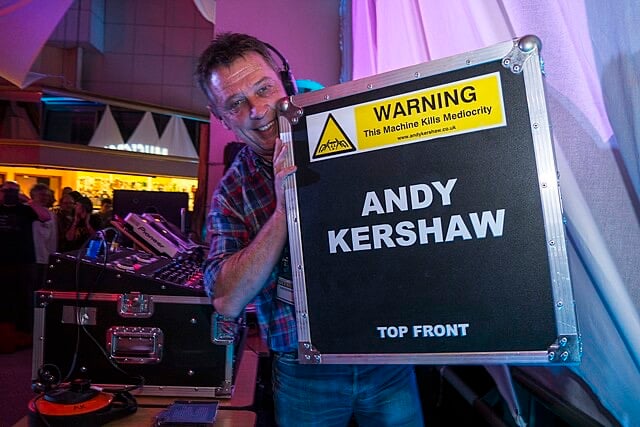
Andy Kershaw, the broadcaster whose three-decade BBC career brought world music and conflict reporting to mainstream British audiences whilst his personal life descended into restraining order violations and repeated imprisonments, has died aged 66 following a cancer diagnosis that left him unable to walk yet characteristically defiant about his determination to survive longer than political leaders and television presenters he held in contempt.
His family confirmed Friday afternoon that Kershaw passed away Thursday evening, eight months after doctors discovered tumours in his spine that had robbed him of mobility yet apparently not the mordant wit that saw him declare in January: “I am in good spirits, feeling very positive and planning another podcast. I am determined not to die before Benjamin Netanyahu, Vladimir Putin, Donald Trump and Ant and Dec. That should keep me going for a while.”
The Rochdale-born presenter spent nearly three decades at the BBC after joining in 1984 to host rock music programme Old Grey Whistle Test, subsequently co-presenting the corporation’s Live Aid coverage before establishing himself as John Peel’s Radio 1 successor from 1985 to 2000. His weekly programme became renowned for eclectic musical selections featuring non-mainstream sounds from global traditions that conventional commercial radio largely ignored—a curatorial philosophy earning multiple Sony Radio Academy Awards whilst establishing him as pivotal figure in British world music appreciation.
Yet Kershaw’s broadcasting achievements proved inseparable from personal catastrophes that saw him jailed three times for breaching restraining orders following the 2006 collapse of his 17-year relationship with restaurateur Juliette Banner, with whom he shared two children. His 2011 autobiography No Off Switch described himself as a “selfish dickhead” incapable of fidelity whilst documenting serial infidelities that ultimately destroyed the partnership and contributed to what he characterised as losing “everything” including his children and the woman he loved.
Why Kershaw’s Eclectic Broadcasting Philosophy Challenged Radio Conventions
Kershaw’s significance extended beyond merely playing unusual music: he embodied alternative approach to radio programming that rejected format rigidity and demographic targeting in favour of following personal enthusiasms wherever they led, trusting audiences possessed curiosity matching his own about musical traditions that mainstream media treated as niche interests unworthy of prime-time exposure.
His travels across conflict zones including Rwanda during the 1994 genocide and Sierra Leone during the final stages of its 2001 civil war demonstrated that his curiosity encompassed geopolitical realities alongside musical cultures, contributing reports to Radio 4’s From Our Own Correspondent, Today programme and The World Tonight that brought war correspondent sensibilities to cultural journalism. Radio diaries from North Korea were among the first programmes recorded inside the hermit kingdom according to the BBC, illustrating his willingness to pursue access that more cautious journalists might have declined given the diplomatic and physical risks such reporting entailed.
The combination of musical adventurousness and conflict zone reporting created presenter persona refusing categorisation within conventional broadcasting templates: neither pure music specialist nor dedicated foreign correspondent but hybrid figure whose interests spanned artistic expression and human suffering in ways that illuminated connections between cultural production and political violence that siloed journalism typically overlooked.
Peter Everett, Kershaw’s close friend and podcast collaborator, described the broadcaster’s final months: “My friend Andy has been going through a difficult time. Last August he was diagnosed with cancer, mainly affecting his spine and making him unable to walk. Since then he has been undergoing treatment, including chemotherapy, radiotherapy, physiotherapy and a lot of scans and painkillers. Although we’ve not been able to put together any podcasts in the last six months, we are very grateful to all the patrons and supporters who have stuck with us.”
The acknowledgment that treatment had prevented podcast production suggested Kershaw remained professionally engaged until physical deterioration made such work impossible—a commitment to broadcasting that persisted across four decades despite the personal disruptions that periodically derailed his career and ultimately contributed to his 2007 departure from BBC Radio 3 where he had moved after leaving Radio 1 in 2000.
What Tumours in His Spine Revealed Last August
The spinal cancer diagnosis arrived during period when Kershaw had rebuilt semblance of stability following the tumultuous 2006-2012 period that saw his relationship collapse, his career implode, and his freedom repeatedly curtailed through imprisonments stemming from his refusal to accept that the partnership with Banner had ended irrevocably.
The tumours’ location explained the mobility loss that transformed a broadcaster whose career had involved extensive international travel into someone confined by physical limitations that chemotherapy, radiotherapy and physiotherapy could only partially ameliorate. His January statement’s dark humour about outliving despised public figures reflected coping mechanism that broadcasting career had cultivated: transforming adversity into material, maintaining sardonic distance from circumstances that might otherwise prove overwhelming.
The inclusion of entertainment duo Ant and Dec alongside Netanyahu, Putin and Trump in his survival target list captured Kershaw’s particular brand of cultural criticism: equally contemptuous of political leaders presiding over wars and populist demagoguery, and mainstream television personalities whose bland professionalism represented everything his broadcasting philosophy rejected. That such levity could coexist with terminal diagnosis illustrated resilience that friends and colleagues identified as defining characteristic persisting even as physical capabilities deteriorated.
The Personal Breakdown That Derailed a Pioneering Career
The relationship with Banner collapsed on their first day relocating to the Isle of Man in 2006 when she borrowed his mobile phone and discovered message from a woman with whom he had conducted one-night stand at Womad festival—an infidelity so casual that Kershaw hadn’t bothered deleting the incriminating evidence yet significant enough to definitively end a partnership that had produced two children and survived previous betrayals.
His autobiography’s characterisation of the encounter as being “of such little significance” alongside descriptions of treating previous girlfriend Melanie “disgracefully” despite her being “the sweetest and most loving” partner illustrated pattern of behaviour that Kershaw himself recognised as destructive yet apparently felt powerless to modify. The self-aware acknowledgment of being “incapable of fidelity” provided explanation without excuse, documenting personality traits that enriched his broadcasting through restless curiosity yet devastated personal relationships requiring sustained commitment and emotional fidelity.
Banner obtained year-long restraining order after Kershaw refused accepting the relationship’s termination, triggering cycle of violations that resulted in three imprisonments and numerous arrests as he attempted maintaining contact despite court orders explicitly prohibiting such communication. A 2012 court appearance saw him pleading: “I have lost my kids. I have lost the woman I love. I have lost everything. It is a very difficult time for me. I just want peace and quiet”—a statement capturing the consequences that his own behaviour had generated yet which he apparently experienced as unjust punishment rather than proportionate response to harassment that restraining orders are designed to prevent.
The six-month suspended sentence and his subsequent departure from the Isle of Man to “address his problems” suggested recognition that continuing the pattern would result in further imprisonment, yet whether genuine rehabilitation occurred or whether he merely learned to avoid legal consequences whilst maintaining underlying attitudes remains unknowable from public record. The final fourteen years between his last known restraining order violation and his death this week saw him largely disappear from public consciousness beyond podcast work with Everett and occasional references in discussions about BBC broadcasting history.
His sister Liz Kershaw, herself a veteran broadcaster with more than three decades in national radio, claimed in 2022 that the BBC had “sacked her from BBC 6 Music because they don’t want women over 60″—allegations the corporation denied whilst pointing to other work she had received including a Radio 2 series on the Queen’s Platinum Jubilee. Her observation that “there are many men in their sixties, seventies and eighties on these pop stations there are hardly any women” identified gender disparity that her brother’s career exemplified: he maintained BBC employment into his forties despite personal scandals that might have ended female broadcasters’ careers far earlier given the double standards that media industries apply to workplace conduct and private behaviour.
For audiences who discovered world music through Kershaw’s Radio 1 programmes, who heard his dispatches from Rwanda and Sierra Leone, or who appreciated his willingness to champion artists and genres that commercial considerations alone would never have permitted airtime, his death marks the loss of broadcaster whose influence extended far beyond the specific programmes he presented. The eclectic philosophy he embodied—trusting curiosity over demographics, following enthusiasms over format requirements—has largely disappeared from mainstream British radio as algorithmic playlisting and risk-averse commissioning have replaced the presenter-driven discovery that characterized the era when Kershaw and Peel could introduce millions to sounds they would never have encountered through conventional media channels.
Whether his personal failings diminish his professional achievements or whether the two can be assessed separately constitutes question that each listener must answer based on their own judgments about how biographical knowledge should affect artistic legacy evaluation. That he apparently died without reconciling with his children or the partner whose trust he destroyed through serial infidelities represents tragedy separate from yet intertwined with the broadcasting career that provided him identity and purpose even as personal relationships collapsed through behaviour patterns he acknowledged yet could not or would not change.
