



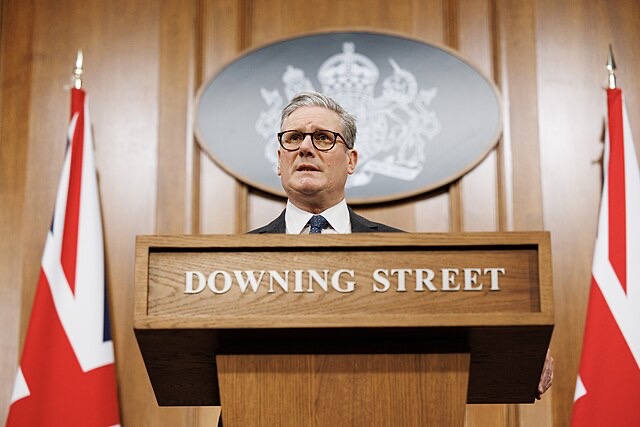
Sir Keir Starmer has delivered a stark national address warning the Iran war’s economic fallout will fundamentally shape Britain’s future, vowing the Government will not permit a return to “business as usual” once fighting concludes.
The Prime Minister’s Downing Street statement on Monday sought to reassure households facing surging energy costs and supply shortages that Britain possesses sufficient resilience to “weather” the storm triggered by President Donald Trump’s Middle East campaign.
“It is now clear that the impact of this war will affect the future of our country,” Sir Keir stated. “So today, I want to reassure the British people that no matter how fierce this storm, we are well placed to weather it, and that we have a long-term plan to emerge from it a stronger a more secure nation.”
The address came moments after Mr Trump disclosed he is “strongly considering” withdrawing the United States from NATO following European allies’ refusal to join Iranian operations—a revelation that threatens the transatlantic security architecture Britain has relied upon since 1949.
Mr Trump branded the defensive alliance a “paper tiger” during an interview with The Telegraph, launching a separate broadside against Sir Keir’s energy policies. “All Starmer wants is costly windmills that are driving your energy prices through the roof,” the President stated.
Sir Keir rejected any suggestion Britain would simply endure the crisis before resuming previous policies, declaring: “I’m not prepared to ask the British people once again, to go through a crisis, and say business as usual, back to the status quo.”
He committed to fundamental reforms across economic policy, energy security and defence capabilities. “So on our economy, on our energy and on our defence, this time will be different. We will make Britain a fairer and more secure country, because that hope is what is needed as the country comes together, and because how we emerge from this crisis will define us for a generation.”
The Prime Minister’s framing positions the Iran conflict’s domestic consequences—including NHS supply shortages, soaring fuel prices and potential rationing—as a transformative moment requiring permanent policy shifts rather than temporary crisis management.
His pledge to avoid returning to the “status quo” echoes rhetoric deployed during the COVID-19 pandemic and energy crisis following Russia’s Ukraine invasion, both of which prompted promises of fundamental change that critics argue failed to materialise.
Separately, Sir Keir confirmed that forthcoming weeks will see Britain host a summit with EU member states aimed at developing “deeper” relationships with Brussels, though he reiterated Labour’s manifesto commitments ruling out rejoining the single market, customs union or restoring freedom of movement.
The announcement represents tangible progress on the party’s 2024 pledge to “reset” European relations, raising questions about how far rapprochement will extend given economic pressures now mounting from Middle Eastern instability.
