



A British military base in northern Iraq was struck by a swarm of Iranian drones overnight, injuring a number of American personnel and setting part of the camp ablaze, while RAF pilots flew sorties over the wider region.
Anti-drone specialists deployed from Britain intercepted a number of the incoming projectiles, and no UK service personnel were reported as casualties. US forces stationed at the base sustained injuries, though none are said to be serious.
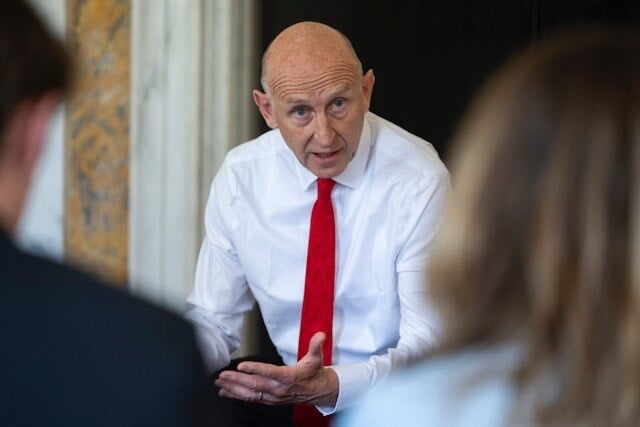
The attack came as Defence Secretary John Healey visited the UK’s military planning headquarters at RAF Northwood, where he was briefed by senior commanders including Lieutenant General Nick Perry and Brigadier Guy Foden. He was informed of further US casualties from Iranian strikes in northern Iraq, and told that RAF pilots had conducted overnight sorties above the UAE, Jordan and Qatar.
Speaking to reporters following the briefing, Healey called for an end to the conflict and urged the public not to judge American intentions solely on the basis of social media output from US defence officials. “Do not take Twitter feeds of figures of the US,” he said, adding that the closure of the Strait of Hormuz and oil prices exceeding $100 a barrel benefited nobody — “except Putin.”
Healey argued that Russia’s Vladimir Putin stood to gain more than any other leader from the current crisis, noting that the spike in global oil prices had boosted Moscow’s war finances at a time when the Kremlin had been struggling to fund its occupation of Ukraine. “Putin is clearly more likely to welcome [the situation] more than anyone else,” he said.
The Defence Secretary also accused Iran of a “major escalation” by mining the Strait of Hormuz, the vital waterway through which significant volumes of global oil trade passes. The UK has already deployed autonomous mine-hunting systems to the region and is in discussions about sending additional assets. Healey defended the return of HMS Middleton to Britain for routine maintenance, describing the vessel as likely redundant in active mining conditions. “It is very difficult to de-mine in those waters without the de-escalation of the conflict,” he said.
On the question of Royal Navy involvement in protecting cargo ships and oil tankers transiting the Strait, Healey described any such mission as still in its “early days,” with no vessels yet prepared for deployment in that role. He maintained that resolving the conflict remained the most effective route to reopening the waterway.
Commanders at Permanent Joint Headquarters also briefed Healey on the tactical similarities between Iranian drone operations and Russian attacks in Ukraine. Tehran has adopted low-altitude flight approaches to evade detection — a method mirroring tactics used in Russia’s assault on Ukraine. Iran has previously supplied Russia with tens of thousands of Shaheed one-way attack drones, with Russian technology embedded in their navigation systems.
“We have seen this axis of aggression, with Russia firing 60,000 drones into Ukraine,” Healey told reporters. “We have seen the same tactics by Iran. These countries like to menace their neighbours. Nobody will be surprised to hear Putin’s hidden hand is behind these tactics.”
Healey also reaffirmed that supporting Ukraine would remain Britain’s foremost defence priority, alongside monitoring threats in the High North region. HMS Dragon, which has since departed for the Middle East, had previously been assigned to operations in that area.
