



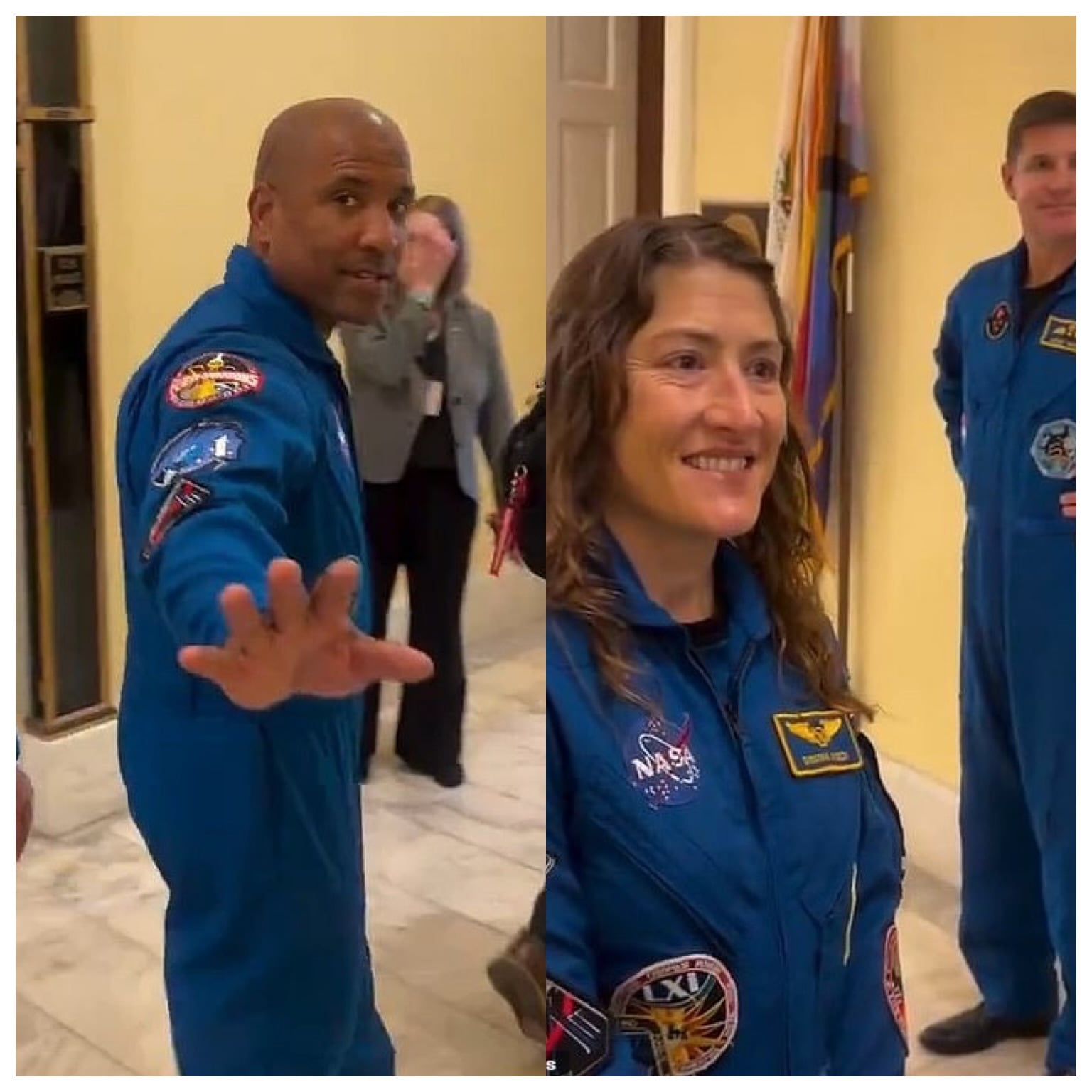
The astronauts who completed a historic trip around the moon earlier this year have found themselves at the centre of an unlikely viral moment — after a conspiracy theorist confronted them on Capitol Hill and accused them of faking the entire mission.
A video of the encounter, which has spread rapidly across social media, shows Reid Wiseman, Victor Glover, Christina Koch and Jeremy Hansen being accosted by an aggressive man as they walked through Washington. “Stop lying! Stop acting! You all never went to space,” the man shouted as the crew approached. The four astronauts responded by largely walking on, apparently doing their best to ignore the outburst.
The man continued his tirade as the crew were ushered away, shouting: “Stop lying to the public! Your psyop isn’t working on millions of us! NASA’s a joke! Repent before God, y’all! I see through your lies!” Glover offered a polite if visibly uneasy wave as the abuse continued.
The clip prompted widespread reaction online, with the majority of viewers praising the crew’s composure. Much of the commentary focused on Koch’s expression during the confrontation. “Christina was too stunned to speak by this level of stupidness,” wrote one user on X. Another added: “She had to smile through that very awkward moment.” A third took a rather less measured view: “They’re so polite, I’d smack him in the face.”
A small number of users sided with the conspiracy theorist, with one writing: “Calling them out in the capital… 100 per cent.” Another added: “Artemis II astronauts being called liars to their faces. Love it.”
The encounter drew immediate comparisons to a notorious incident in 2002, when Apollo 11 astronaut Buzz Aldrin was confronted by moon-landing denier Bart Sibrel under similar circumstances. Aldrin, then 72, resolved that particular argument rather more directly — by punching Sibrel in the face. The Artemis II crew chose a more diplomatic approach.
Claims that the mission was fabricated are straightforwardly contradicted by the available evidence. NASA livestreamed the entire ten-day mission, thousands of people watched the launch in person at Kennedy Space Centre in Florida, and the crew returned with an extensive record of scientific observations — including the discovery of new craters on the moon’s far side and real-time footage of meteor impacts.
Nevertheless, the mission had attracted conspiratorial attention even before launch, having been subject to a series of delays and organisational setbacks that some used to fuel suspicion. Dr Daniel Jolley, an expert on the psychology of conspiracy theories at the University of Nottingham, told the Daily Mail that the mission’s profile made it a natural target. “Space exploration is complex, highly symbolic, and led by powerful institutions, which can make it a target for suspicion among some groups,” he said.
