



Tens of thousands of protesters have poured into central London for two rival demonstrations in what police have described as an unprecedented policing operation costing £4.5 million, as the city simultaneously hosts the FA Cup final at Wembley.
Around 80,000 people are expected across both events — an estimated 50,000 at Tommy Robinson’s Unite the Kingdom rally and a further 30,000 at the annual pro-Palestine Nakba Day march. Some 4,000 officers have been deployed, with 660 drafted in from forces outside the Metropolitan Police, alongside armoured vehicles, horses, dogs, drones and helicopters. By 1pm, eleven arrests had been made for a variety of offences.
Met Police Deputy Assistant Commissioner James Harman described the scale of the operation as “unprecedented in recent years,” adding: “We are policing two significant and potentially challenging protests in the centre of London, as well as the FA Cup final, which is taking place at Wembley on the same day. We’re doing this at a time of continued global instability and tension, which we know has the potential to fuel tension and play out on the streets of London. The terrorism threat level has been raised to severe, and in recent weeks and months, we have seen a terrorist attack.” The Metropolitan Police Federation warned that many officers had had leave cancelled and rest days withdrawn, adding bluntly: “There are not enough of us.”
Unite the Kingdom supporters, waving Union Jack and St George’s flags, began gathering as early as 9am. The march set off from Kingsway, moving through Aldwych, the Strand and Trafalgar Square before ending at Parliament Square, where Robinson addressed the crowd. Taking to the stage at 1.35pm, Robinson — whose real name is Stephen Yaxley-Lennon — told supporters: “Are you watching Keir Starmer? Today, I want to ask you all something, are you ready for the Battle of Britain? In 2029, we have an election. If we don’t register to vote, if you don’t become an activist, we will lose our country forever.”
Chants of “Keir Starmer is a w*****” and “We want Starmer out” rang out along Kingsway, while cries of “Oh Tommy Tommy” and “We want freedom” were heard throughout the march. Police were seen confiscating cans of alcohol from supporters after Westminster Council issued a public spaces protection order banning people from carrying drinks in cans and bottles.
Among those in attendance was Kim Anderson, 68, from Norwich, who said she had come to “rid Britain of Starmer, once and for all.” She told reporters: “I’m fed up of Starmer. This country is a mess. I am disgusted for being called far-right. All I want is an end to the ridiculous amounts of immigration and billions being spent on people doing nothing to contribute to this country.” Sandra Dilks, 45, from Epping, Essex, said: “We’ve had enough of Keir Starmer. He’s a disgrace and he has ruined this country.” Janine Ponting, 35, had made a 12-hour journey from Newcastle. “Our country is over. We need radical change,” she said. “Today, we’re sending a message that we’ve simply had enough.”
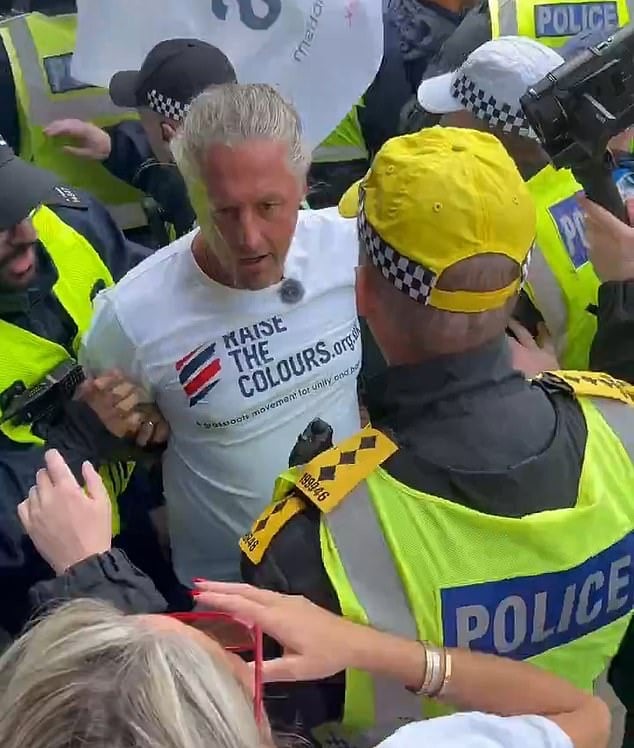
Arrests came quickly after the march got underway. Footage showed a man believed to be Raise the Colours leader Ryan Bridge being handcuffed outside Euston Station as flag-waving protesters hurled abuse at officers. The Met also confirmed that two men wanted on suspicion of grievous bodily harm following an incident in Birmingham — in which a man was run over by a van after a group attempted to remove Union Jack flags put up by Raise the Colours campaigners in Stirchley on Thursday — were arrested at Euston after being spotted arriving in London to attend the rally.
The pro-Palestine Nakba Day march, which marks the displacement of Palestinians in 1948 with the founding of Israel, assembled at Exhibition Road in Kensington before moving through Knightsbridge and Piccadilly, ending at Waterloo Place. Shortly before setting off, chants of the controversial phrase “from the river to the sea” were heard. A woman was arrested after she refused to remove a fabric face mask, as officers asked all those wearing face coverings to remove them. A separate group wearing orange jumpsuits with masks bearing the image of Reform UK leader Nigel Farage were also asked to remove their coverings. Some placards carried anti-Semitic slogans, while others bore messages including “Smash the far right” and “Stop Farage, Stop Trump.”
A police sterile zone was established between the two marches to prevent confrontations. For the first time in a protest policing operation, live facial recognition cameras were deployed — positioned in an area of Camden not on the Unite the Kingdom route but expected to be heavily used by attendees. Biometrics and Surveillance Camera Commissioner Professor William Webster cautioned that police forces could face legal challenges over their use of the technology, warning it was not “foolproof.”
In a significant legal first, organisers of both rallies face potential prosecution alongside any speakers who incite hatred or extremism. Director of Public Prosecutions Stephen Parkinson said: “This is not about restricting free speech. It is about preventing hate crime and protecting the public, particularly at a time of heightened tensions.” Offences of stirring up hatred under the Public Order Act carry a maximum sentence of seven years.
The government banned eleven foreign nationals from entering the UK ahead of the rally, including Polish MEP Dominik Tarczyński, Belgian politician Filip Dewinter, anti-Islam commentator Valentina Gomez and Dutch activist Eva Vlaardingerbroek. Prime Minister Starmer described the march as a “stark reminder” of what the country is “up against,” writing on social media as the protest got underway: “Today the voices of division will be loud. They don’t speak for the country I know, one that belongs to all of us. That’s our Britain. A Britain worth fighting for.”
Deputy Prime Minister David Lammy pledged that peaceful protest would always be protected but warned that violence would be met with “swift” action with “extra court capacity in place.” Counter-demonstrators and anti-racism groups also made their voices heard. Daniel Kebede, general secretary of the National Education Union, said he was marching “to show that we will not allow Tommy Robinson and the far right to divide our communities.” Stand Up To Racism co-convener Sabby Dhalu warned that the far right was attempting to “exploit the cost-of-living crisis by stirring up racism and falsely blaming migrants and refugees for people’s hardships,” adding: “History shows where this kind of politics can lead.”
Home Secretary Shabana Mahmood said: “The right to protest is a cornerstone of our democracy. But anyone spreading hate or committing acts of violence will face the full force of the law.” Downing Street echoed the warning, saying law-abiding protesters would be protected but those attempting to “break the law and create chaos” should expect to “feel the full force of the law.”
