



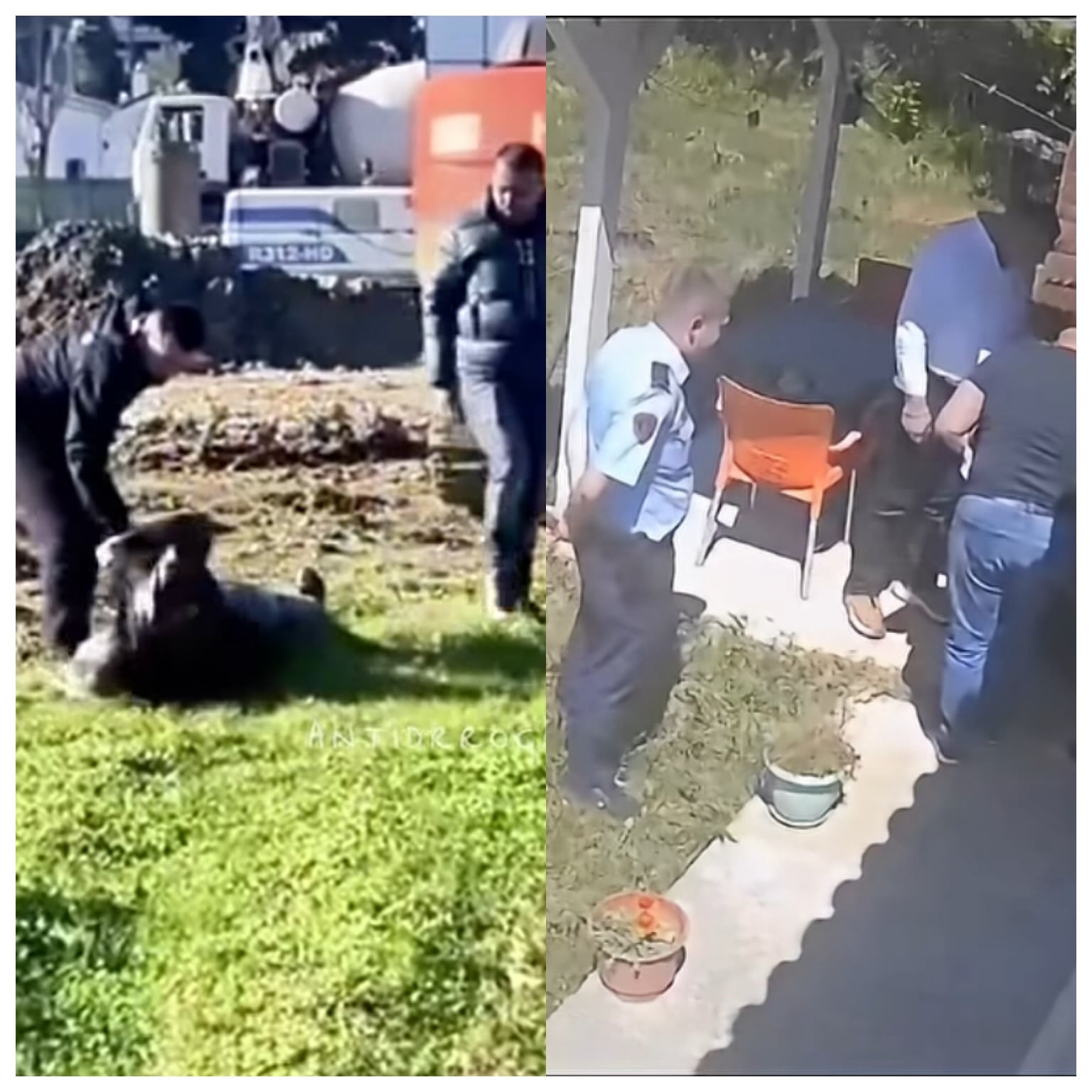
Britannia Daily has obtained disturbing video footage appearing to show an Albanian man beaten unconscious on his own land by two younger men who had allegedly been carrying out illegal excavation and construction work there without his consent — before police turned their attention not to the attackers, but to the victim’s own family.
The victim, identified by Britannia Daily as Rexhep Ademi, can be seen on the ground being struck repeatedly. A Hitachi excavator is visibly present in the background of the footage, placing the attack directly on the land in dispute. A woman, believed to be a relative, can be heard in evident distress pleading for the violence to stop. Mr Ademi loses consciousness during the assault, yet the attack continues. According to sources, the incident left him in a serious physical condition.
Durrës Police have since issued a formal response to the footage, which they say was originally published on the Facebook account of a lawyer identified only as A. Ll. According to the police statement, the attack on Mr Ademi actually took place on 22 December 2025, and materials relating to the incident were referred to the Prosecutor’s Office on the same date. Criminal proceedings were initiated against the two men appearing in the video, identified by police only as D. Sh. and B. M., on suspicion of punching and kicking Mr Ademi — whom they claimed had insulted them during a dispute over property.
What followed was, if anything, even more disturbing. In a separate set of recordings captured by security cameras powered by solar panels — after the electricity supply to the property was allegedly cut off prior to officers’ arrival — police from the Golem Police Post, led by its head Enio Ruçi, are alleged to have subjected Mr Ademi’s mother, Ishe, to violent treatment before arresting her. According to a formal public complaint, the footage captures the order “kick her while she’s down,” with officers suspected of dragging and physically assaulting the elderly woman before detaining her.
Durrës Police, however, offer a markedly different account of those events. According to their statement, officers from the Kavaja Police were notified on 4 May 2026 that Ishe — whom police identify as Sh. A. and give an age of 69, differing from the age of 75 cited in the public complaint — had sprayed fuel on and then set fire to a container at a construction site owned by a citizen identified as A. L. Police allege that at the time of her escorting, she violently resisted officers, hitting and biting them. To avoid any conflict of interest, the procedural actions were carried out by a Judicial Police officer from the Prosecutor’s Office at the Court of First Instance of General Jurisdiction of Durrës. Proceedings have been initiated against her in a free state for the criminal offences of destruction of property by fire and opposition of a public order police officer.
The police statement also references two earlier related incidents. On 24 March 2026, Ishe herself had reported to Kavaja Police that her property had been unlawfully taken from her, alleging she had been excluded as an heir. Just weeks later, on 15 April 2026, a separate complaint was filed against her by a citizen identified as E. M., who alleged she had destroyed the fence of a construction site he manages. Procedural materials for both cases have been referred to the Prosecutor’s Office.
Those raising the original allegations remain firm in their characterisation of the intervention, describing it as a calculated show of force against a vulnerable family rather than legitimate policing. They accuse the officers involved of acting not as protectors of citizens but as instruments of pressure, violence and humiliation. Further suspicions have been raised by claims that, following the violence, those responsible stated openly that they intended to go to the police themselves — an assertion the complainants say points to possible institutional protection and suspected links between criminal activity and local law enforcement.
Sources who approached Britannia Daily allege that the two original attackers have connections to organised criminal groups operating in Albania that unlawfully seize land from private citizens and develop it for commercial purposes, including resorts and other business ventures.
Britannia Daily has also learned that Mr Ademi had staged a protest outside SPAK — Albania’s powerful anti-corruption prosecutorial body — in the months before the assault. SPAK holds a broad mandate to investigate and prosecute high-level corruption, organised crime, human trafficking and abuses of power by public officials, including ministers, judges and senior police figures.
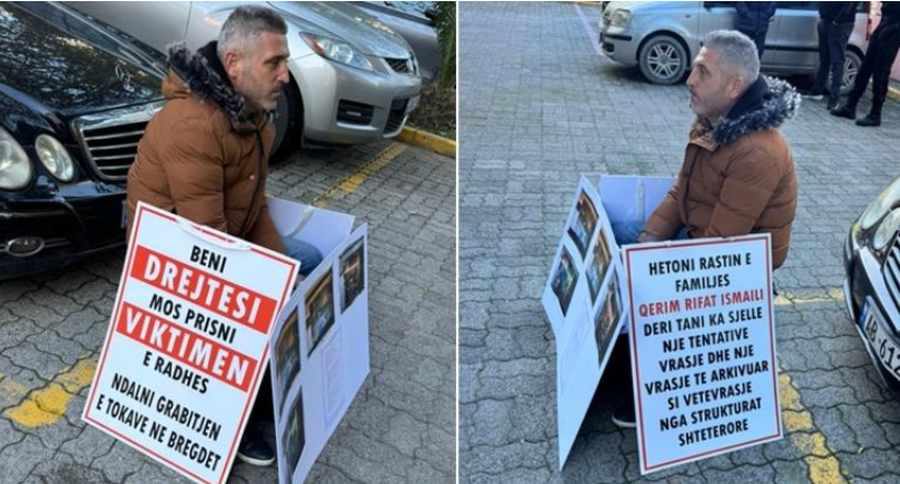
Mr Ademi in front of SPAK court protesting
The incident sits against a backdrop of deepening concerns over the rule of law in Albania. By 2024, more than 60 senior officials — among them ministers, MPs, mayors, judges and police chiefs — had been investigated or charged with corruption offences, according to available records.
It is not the first time alleged failures in the Albanian justice system have provoked a dramatic response. In a separate case, a citizen named Mr Shkëmbi opened fire on Judge Kalaja in a courtroom immediately after losing a property dispute, firing several times with a pistol he had concealed on his person. He had maintained throughout proceedings that he held original documentation proving ownership of the land.
Durrës Police stated: “The Durrës Police guarantees citizens that it is maximally committed to handling quickly and professionally any indication, notification and denunciation of illegality or violation of their rights.”
Britannia Daily has approached Albanian authorities for further comment.
