



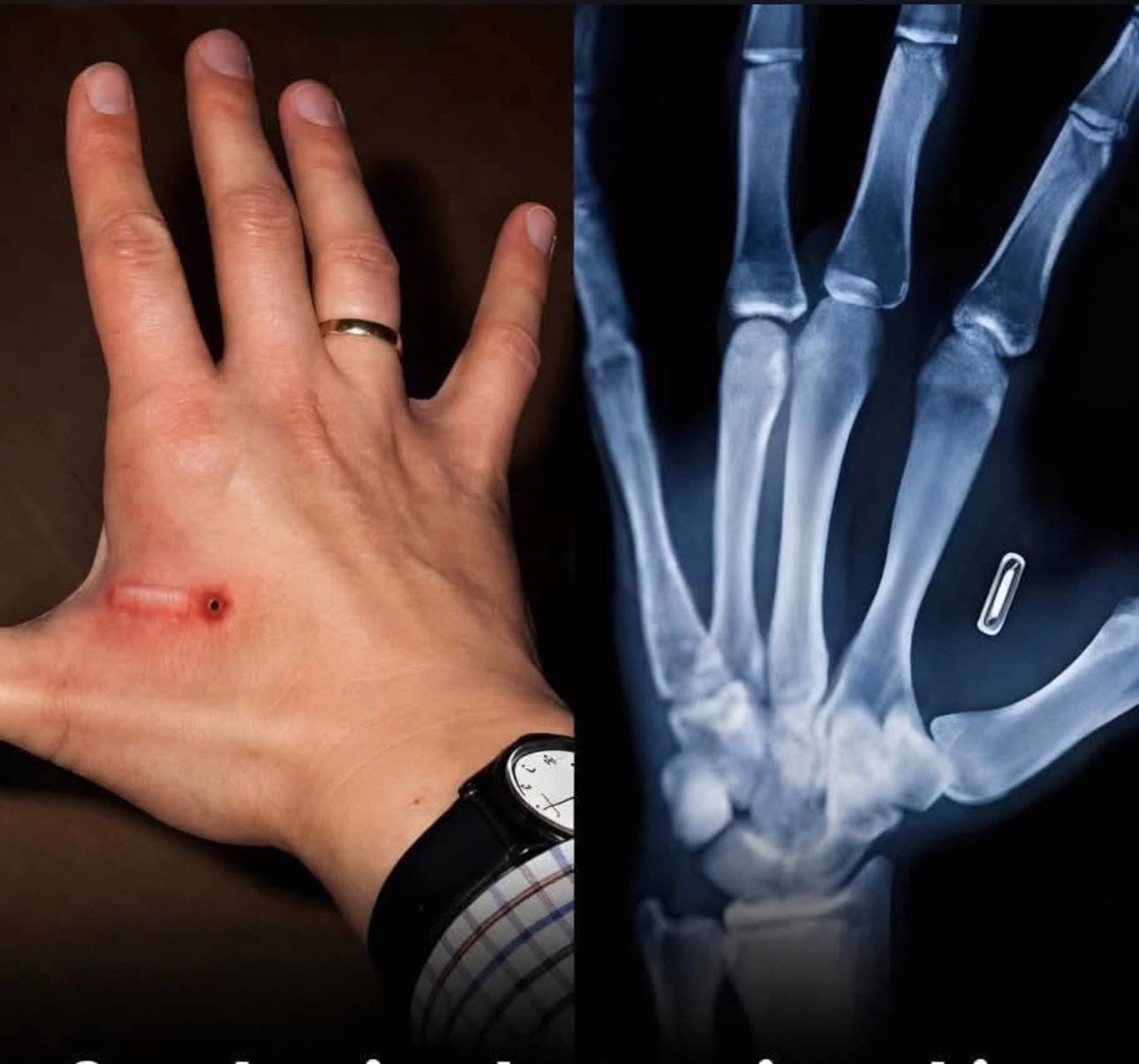
Thousands of people in Sweden have voluntarily had tiny microchips implanted in their hands, allowing them to unlock doors, pay for goods and access public transport with a simple wave of the wrist — a trend that has been circulating online for years but continues to spark fresh waves of alarm and conspiracy theories each time it resurfaces.
Around 4,000 to 6,000 Swedes are estimated to have undergone the procedure since it first gained traction around 2015, according to industry figures — a niche but growing community of tech enthusiasts drawn by the convenience of ditching keys, cards and gym passes in favour of a chip the size of a grain of rice implanted beneath the skin between the thumb and index finger.
The devices are passive NFC or RFID chips, identical in technology to those found in contactless bank cards, biometric passports and pet microchips. They contain no battery, emit no signal of their own and can only be read when held within a few centimetres of a compatible scanner. There is no GPS tracking capability, no constant broadcasting and no connection to any external network. The chips are, in effect, a contactless card that happens to be under the skin.
The trend was largely pioneered in Stockholm, where biohacking firm Biohax International, founded by Jowan Österlund, partnered with the Epicenter co-working hub to offer implant events for members. Those gatherings — entirely public and voluntary — attracted significant media attention and helped establish Sweden as the global centre of the human microchip movement. The country’s highly digitised society and general openness to technology adoption created fertile ground for a trend that might have struggled for acceptance elsewhere.
Common uses include accessing office buildings, logging into gym facilities, storing digital contact information and, in some transit systems, carrying public transport tickets. Users consistently cite the convenience of having their most frequently used digital credentials literally on hand at all times.
The online reaction to the trend has often been less measured. The story has repeatedly attracted conspiracy theories suggesting mandatory government chipping programmes, surveillance schemes or connections to broader population control narratives — none of which bear any relation to what is actually a small-scale voluntary biohacking culture with no state involvement whatsoever. Sweden’s government has no microchip programme and has never proposed one.
Critics with more grounded concerns have raised legitimate questions about long-term safety, the security implications of implanted data and the potential for exploitation by employers or institutions if chip use were ever to become socially or professionally expected rather than genuinely voluntary. Those concerns remain live in bioethics circles, even if the current reality of a few thousand tech hobbyists in Stockholm is considerably more mundane than the fears being expressed online.
