



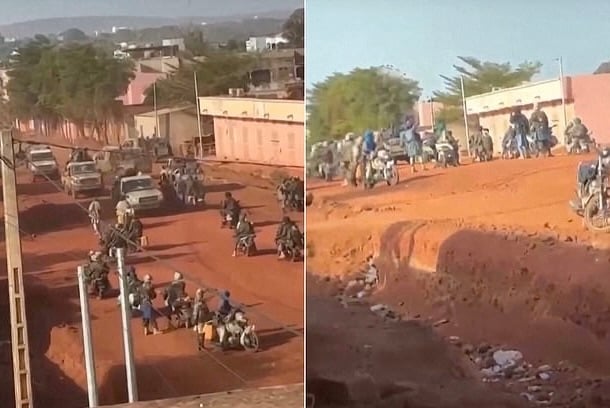
The British government has ordered all UK nationals in Mali to leave the country immediately following a devastating wave of coordinated attacks that has left the West African nation’s military government fighting for its survival and its Russian-backed forces on the back foot.
The Foreign, Commonwealth and Development Office issued an emergency travel advisory advising against all travel to Mali and calling on those already in the country to depart by commercial flight without delay. “If you’re in Mali, you should leave immediately by commercial flight if you judge it safe to do so,” the statement said. Overland routes to neighbouring countries were explicitly ruled out as too dangerous given terrorist activity along major national highways. The FCDO warned of a “high threat of kidnapping and criminal activity across Mali, including in the capital, Bamako,” and told those who chose to remain that they did so “at your own risk” with no expectation of government assistance.
France issued a near-identical warning to its citizens, urging them to leave “as soon as possible” and advising those still in the country to stay at home, restrict movement and follow instructions from local authorities until departure was possible.
The warnings follow a coordinated dawn offensive launched on Saturday by two groups that have historically been adversaries — West Africa’s al-Qaeda affiliate, the Group for the Support of Islam and Muslims, known as JNIM, and the Tuareg-dominated Azawad Liberation Front. The alliance struck Mali’s main army base and areas near Bamako’s international airport simultaneously, while also pushing Russian paramilitary forces backing the junta out of the strategically important northern town of Kidal. It was the largest attack on the country in nearly 15 years.
At least 23 people were killed across two days of intense fighting, according to a hospital source who spoke to AFP. Among the dead was Defence Minister Sadio Camara, widely considered the principal architect of Mali’s decision to align itself with Russia and distance itself from its former Western partners. Russian troops, deployed under the Wagner-linked Africa Corps framework to prop up the junta, suffered a significant setback with the loss of Kidal.
Mali’s junta leader Assimi Goita disappeared from public view entirely for three days following the attacks, prompting open speculation about the stability of his government. He finally broke his silence on Tuesday evening with a state television address in which he acknowledged the situation was one “of extreme gravity” while insisting security arrangements had been reinforced and the situation was now “under control.” He urged Malians not to panic and to resist what he framed as an attempt to fracture the nation. “The country needs clarity, not panic,” he said.
Earlier on Tuesday, Goita’s office released photographs of him meeting wounded soldiers, civilians and Russian ambassador Igor Gromyko, who used the encounter to “reaffirm his country’s commitment to stand with Mali in the fight against terrorism.” Jihadist and separatist forces, however, remained positioned across the country’s north, and jihadist groups had threatened to blockade Bamako itself earlier the same day — a threat that underscored the precariousness of the junta’s position despite Goita’s reassurances.
