



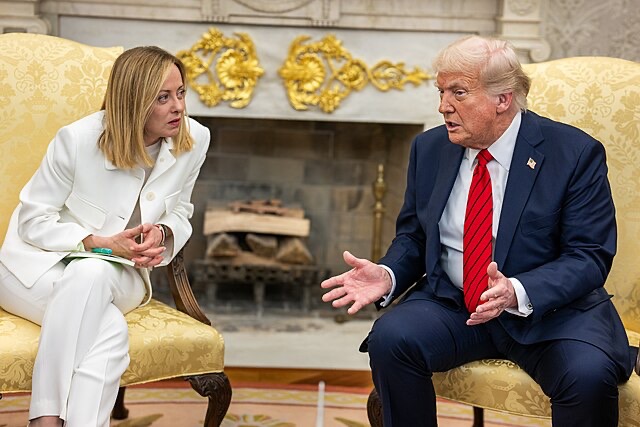
President Donald Trump faces a fresh European rebuke after Italian defence officials barred American warplanes from landing at a strategic Sicilian installation last week, citing failure to seek proper authorisation under bilateral treaty obligations.
Defence Minister Guido Crosetto ordered the access denial when he discovered US bombers intended to use the Sigonella air base without consulting Italian authorities, according to reports emerging on Tuesday despite the incident occurring “a few nights” earlier.
Mr Crosetto stated that treaty provisions governing American military installations on Italian soil require explicit permission from Rome’s defence leadership before operations can proceed. Washington would be permitted to utilise Italian bases “only after explaining what it intends to use them for and only after authorisation from the Italian government,” he explained.
Initial assessments determined the American flights were neither “normal nor logistical” in nature, prompting the access rejection. The Italian defence ministry declined immediate comment when contacted.
The confrontation positions Rome amongst a growing European coalition resisting Washington’s military campaign against Tehran, which commenced on 28 February. Prime Minister Giorgia Meloni has characterised the joint US-Israeli operation as “outside the scope of international law” whilst acknowledging the Islamic Republic’s regional security threat.
The right-wing leader’s criticism marks a notable shift for a politician who has cultivated a reputation as amongst Europe’s most dependable American allies. Centre-left opposition parties have urged her administration to comprehensively block US base access to prevent Italian involvement in the conflict.
Ms Meloni’s government has indicated it would seek parliamentary authorisation should formal American requests materialise, though the Sigonella incident suggests Rome is prepared to enforce treaty compliance regardless of political pressure from Washington.
Spain has adopted an even more confrontational stance, with Prime Minister Pedro Sanchez refusing American requests to utilise Madrid’s military installations for Iranian operations despite Mr Trump’s threats to sever bilateral trade.
Mr Sanchez warned parliament last Wednesday the Middle East conflict presents a “far worse” scenario than the 2003 Iraq invasion. “This is not the same scenario as the illegal war in Iraq. We are facing something far worse. Much worse. With a potential impact that is far broader and far deeper,” he stated.
The Socialist premier characterised the campaign as “an absurd and illegal war” that undermines economic, social and environmental objectives, drawing parallels to Iraq’s aftermath including fuel price surges, migration crises and jihadist attacks across Europe.
The dual European rejections suggest widening transatlantic divisions over Middle East military engagement, with traditional allies increasingly willing to invoke treaty obligations and domestic law to resist American operational demands.
