



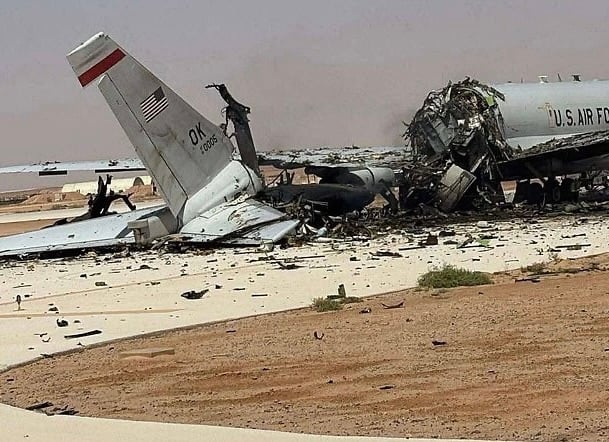
The US Air Force has suffered the loss of one of its most vital surveillance assets after Iranian missiles struck Prince Sultan Air Base in Saudi Arabia, leaving approximately 15 American troops wounded and destroying a key early warning aircraft.
Around five service members sustained serious injuries in Friday’s coordinated assault, which saw Tehran launch six ballistic missiles and deploy 29 drones against the installation located roughly 60 miles from Riyadh, according to PBS reports.
Images reportedly captured at the Royal Saudi Air Force-operated facility reveal the devastated remains of an E-3G Sentry airborne warning and control aircraft, identified by Air and Space Forces magazine as tail number 81-0005 from the 552nd Air Control Wing based at Tinker Air Force Base in Oklahoma.
The photographs show catastrophic structural damage, with the jet’s midsection blown apart and internal components exposed in a tangled wreck. A separate image depicts the detached tail section collapsed onto the runway surrounded by debris, whilst personnel in protective equipment can be seen beneath the aircraft’s wing.
Damage appears concentrated on the rear section housing the rotating radar dome and sensitive electronics crucial to the aircraft’s surveillance capabilities. The loss further depletes the already limited E-3 fleet, a cornerstone of American air operations providing real-time command, control and surveillance across expansive battle spaces.
Prince Sultan Air Base has endured repeated targeting since hostilities commenced, with this latest barrage representing one of the most significant direct hits on US military infrastructure in the region. An earlier strike this week wounded 14 American troops, whilst another incident damaged a US aircraft without causing casualties.
The American casualty count has surpassed 300 since the conflict entered its second month. Central Command confirmed most wounded personnel have resumed duties, though approximately 30 remain unable to serve and at least ten have sustained serious injuries.
The war has claimed 13 US service members’ lives, including Army Sgt. Benjamin N Pennington, 26, who died after being wounded in a 1 March attack on the same installation.
Washington has deployed what officials characterise as the largest American military presence in the Middle East in over two decades, with roughly 50,000 troops now stationed across the region supported by multiple warships and two aircraft carriers. The USS Tripoli amphibious assault vessel arrived recently carrying approximately 2,500 Marines, alongside the USS Boxer and additional Marine units.
The conflict has expanded beyond isolated strikes, with Iran targeting Israel and Gulf Arab states whilst leveraging control of the Strait of Hormuz to disrupt global energy markets. The restrictions have affected oil exports, elevated fuel costs and destabilised international supply chains.
President Donald Trump has demanded Iran reopen the strait, setting an April 6 deadline as diplomatic efforts continue, though Tehran maintains it is not engaged in negotiations.
