



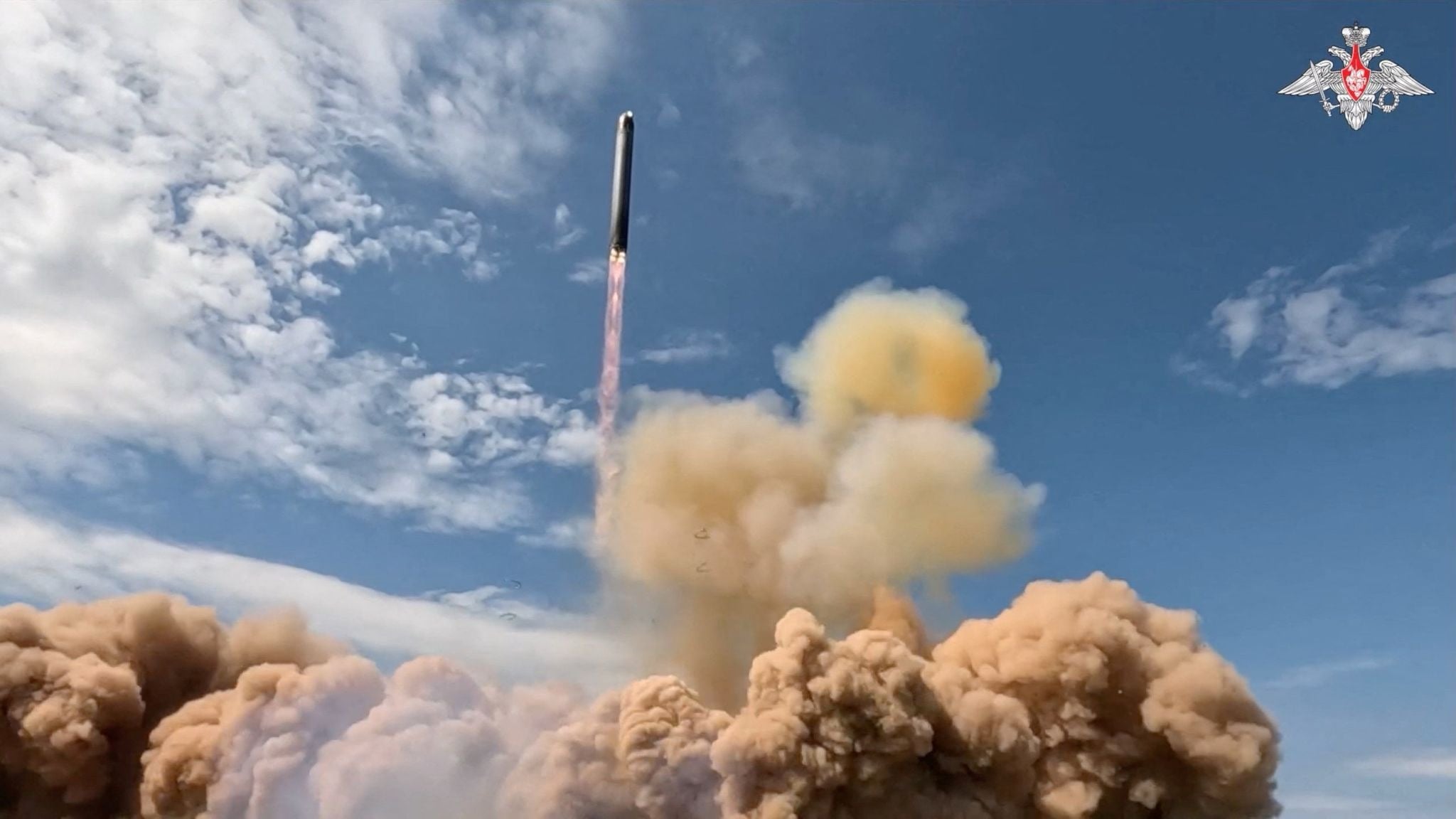
Vladimir Putin has announced that Russia will deploy its Sarmat intercontinental ballistic missile — which he described as the world’s most powerful nuclear weapon — by the end of this year, in a move that combines a significant military statement with what analysts see as a carefully timed show of strength.
Speaking in televised comments, Putin said the Sarmat had a nuclear yield more than four times that of any Western equivalent and a range exceeding 21,750 miles. “It has the ability to penetrate all existing and future anti-missile defence systems,” he declared. State television broadcast footage of missile force commander Sergei Karakayev reporting to the president on what he described as a successful test of the weapon on Tuesday. “The deployment of launchers equipped with the Sarmat missile system will significantly enhance the combat capabilities of the ground-based strategic nuclear forces,” Karakayev said.
The announcement comes after years of delays and technical setbacks. A test launch in 2024 left a deep crater at the launch silo, according to Western experts, and analysts have consistently cautioned that Putin has a pattern of exaggerating the capabilities of Russia’s new generation of nuclear weapons — part of a broader modernisation programme he launched in 2018.
The timing of the announcement is notable. It came alongside Kremlin-released footage of Putin driving through Moscow and presenting flowers to a former school teacher — imagery widely interpreted as a deliberate attempt to rebut recent Western media reports, citing European intelligence, which claimed security around the president had been dramatically tightened and that he was now spending weeks at a time in bunkers due to fears of assassination or a coup attempt. Russian officials dismissed those reports, and the relaxed public footage appears designed to project an image of a leader firmly in command.
Putin also used the occasion to claim the war in Ukraine was drawing to a close, saying “victory has always been and will be ours” — remarks made in the aftermath of a notably scaled-back Victory Day parade held amid a three-day ceasefire. The reality on the ground tells a different story. Meaningful peace negotiations have stalled, the frontline has remained largely frozen for months, and drone warfare continues to impose severe constraints on offensive operations for both sides.
The Russian president has repeatedly raised the spectre of nuclear weapons since the start of the Ukraine war, using the threat as a deterrent against greater Western intervention. Those threats have largely been dismissed by Western governments as sabre-rattling, given the catastrophic response any Russian nuclear strike would inevitably provoke. Russia nonetheless maintains the world’s largest nuclear arsenal. According to Sky News, the Federation of American Scientists estimated last year that Russia holds nearly 5,500 warheads, with just over 1,700 deployed and ready for use.
