



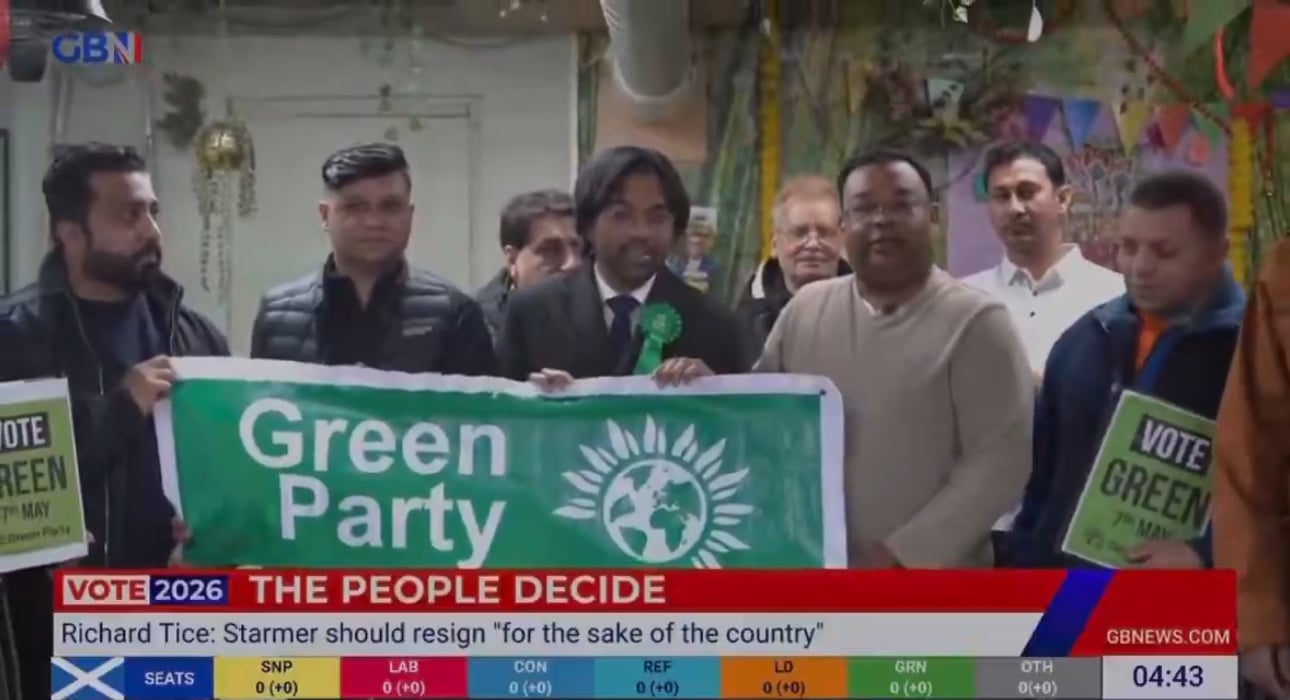
Green Party candidates who won council seats in Thursday’s local elections delivered victory speeches in Bengali and Arabic rather than English, in scenes that have sparked debate about identity politics and community representation in British civic life.
Footage from Newham in east London, one of the areas where the Greens made gains, shows a newly elected councillor opening with “As-salamu alaykum” — the traditional Arabic Islamic greeting meaning “peace be upon you” — before switching to Bengali to address what he described as “our Bangladesh community.” Supporters holding Green Party banners and Vote Green placards cheered throughout. The speech was largely inaccessible to English speakers.
Newham is home to one of the largest Bangladeshi-origin populations in the UK, with the community making up a significant proportion of the electorate in several wards. The Green Party has spent recent months actively courting Muslim voters disillusioned with Labour over Gaza and foreign policy, and Thursday’s results suggest that strategy is bearing fruit in heavily South Asian areas of London.
The scenes are not without precedent within the party. In 2024, Green councillor Mothin Ali — now a party co-deputy leader — shouted “Allahu Akbar” during his victory speech in Leeds’ Gipton and Harehills ward, dedicated his win to Gaza and Palestine, and was accompanied by supporters waving a Palestinian flag. The party has since continued to expand its presence in areas with large South Asian Muslim populations, running campaign materials in Urdu, Bengali and Arabic alongside English.
Critics have argued that victory speeches delivered primarily in a foreign language by elected UK officials represent a significant departure from the expectation that English serves as the common language of public life — particularly for those taking on a representative role. Council meetings and local government business across England are conducted in English. No law prevents councillors from speaking in other languages, but the practice has fuelled debate about whether such targeted community messaging reinforces parallel social spheres rather than bridging them.
Defenders of the approach argue that politicians have always spoken to their voters in the most effective way possible, and that candidates reflecting the language and culture of the communities that elected them is an act of inclusion rather than division. In a borough as diverse as Newham, they say, expecting English-only communications is itself exclusionary.
The broader picture from Thursday’s results points to the Greens consolidating a new electoral coalition — one built less on traditional environmental concerns and more on identity politics, anti-war sentiment and disillusionment with both Labour and the Conservatives in urban, ethnically diverse constituencies.
