



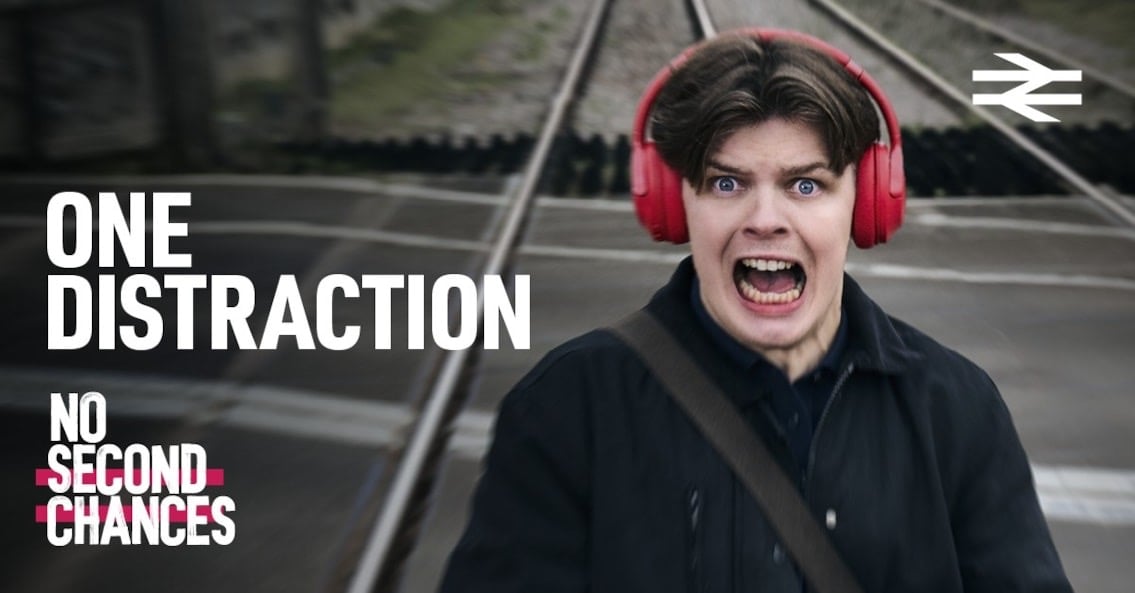
A new cross-industry safety drive has been launched after fresh research laid bare a striking gulf between how safe young adults feel at level crossings and the physical realities of the trains bearing down on them. The figures suggest the South East, one of the most densely crossed parts of the rail network, has a particular problem — and the industry’s response, the first unified campaign of its kind, is pitched squarely at the generation most likely to be distracted on the tracks.
What the research actually found
The survey, commissioned by Network Rail and conducted by Censuswide among 2,001 UK adults between 8 and 10 April, produces a set of numbers that sit uncomfortably alongside one another. Eight in ten people aged between 18 and 34 say they understand the risks of level crossings. The same proportion, however, fail to recognise the key warning signs that a train is approaching. Seven in ten of those young adults are confident they could step out of the way in time if a train came into view while they were still on a crossing. Trains, in practice, routinely travel up to five times faster than a car on a motorway; a service moving at 80mph needs roughly a mile to come to an emergency stop. Some 98 per cent of the young adults surveyed had no idea that was the case.
The regional picture is scarcely more reassuring. In the South East, 95 per cent of respondents were unaware of the one-mile stopping distance, and 60 per cent believed they could dodge an oncoming train if it appeared mid-crossing. A quarter admitted to chatting with others while crossing, 17 per cent said they left their headphones in, and 14 per cent conceded they had been on their phones. The generational gap on headphones is especially stark: 26 per cent of 18 to 34-year-olds nationally said they kept theirs on, compared with 13 per cent of those aged 55 and above.
There are 323 level crossings on the Kent route alone. Each is equipped with some combination of full or half-barriers, flashing lights and audible alarms; the type and severity of the protections vary with location and traffic. The basic instructions, however, are the same at every one: stop, look, listen, obey the signs, check in both directions, and cross briskly once the way is clear.
A unified industry response, launched against a grim backdrop
The campaign — branded No Second Chances — is the first level-crossing safety initiative to be mounted jointly across the industry. Network Rail, the major train operators and the British Transport Police have pooled resources behind it, with the launch held at London Liverpool Street on Tuesday 21 April and a programme running through to 3 June across social media, digital platforms and outdoor advertising. Its centrepiece is a set of uncompromising 20-second films built around the consequences of distraction on the tracks.
The timing is not incidental. The campaign follows a series of recent fatalities at level crossings and arrives as the industry begins to consolidate under the new Great British Railways structure, which is intended to bring track and train into a single operational family. A coordinated national safety push, industry figures argue, is easier under that architecture than it has been in the fragmented arrangements of the past three decades.
The Rail Minister, Lord Hendy, framed the message in plain terms, urging the public to follow the campaign’s advice and to “always pay attention at level crossings”. Priti Patel, chief health, safety and wellbeing officer for the South Eastern Railway, acknowledged how easily familiarity slips into complacency — a favourite podcast, a glance at a phone, a well-trodden route home — and said the point of the campaign was to make clear that “stepping onto a level crossing without stopping to look and listen can be fatal”. Samantha Facey, safety director for Southern, Thameslink and Gatwick Express, put the physical reality still more bluntly: the trains run faster than motorway traffic, and take up to a mile to stop. Chief Inspector Joseph Gorman of the British Transport Police noted that officers respond to crossing misuse incidents every month, and warned that the force would continue to pursue prosecutions where people deliberately ignored warnings — saving a few seconds, he said, is never worth the risk.
Why confidence is the dangerous variable
The strategic logic behind the campaign is that the problem at modern level crossings is rarely ignorance of their existence. The overwhelming majority of young adults surveyed describe themselves as risk-aware. The difficulty is that this sense of awareness is decoupled from any working knowledge of how trains actually behave. A belief that you can outrun, outstep or outmanoeuvre an oncoming service rests on the assumption that a train is broadly like any other fast-moving vehicle — something that brakes within the distance the eye can judge. It isn’t. At 80mph, by the time a driver has sight of someone on a crossing, the physics of the situation have already made evasive action impossible.
That gap between perceived and actual risk is precisely what the 20-second films are designed to close. The hope of the industry is that confronting viewers with the stopping distances, the speeds and the consequences — rather than relying on generic warnings to take care — will shift behaviour in a group that has proved stubbornly harder to reach through conventional signage. Whether it works will be judged in the figures that come out of this year’s crossings, rather than in any poll. For now, the message the campaign is asking young adults in the South East to internalise is a simple one. The train cannot stop in time. You have to.
