



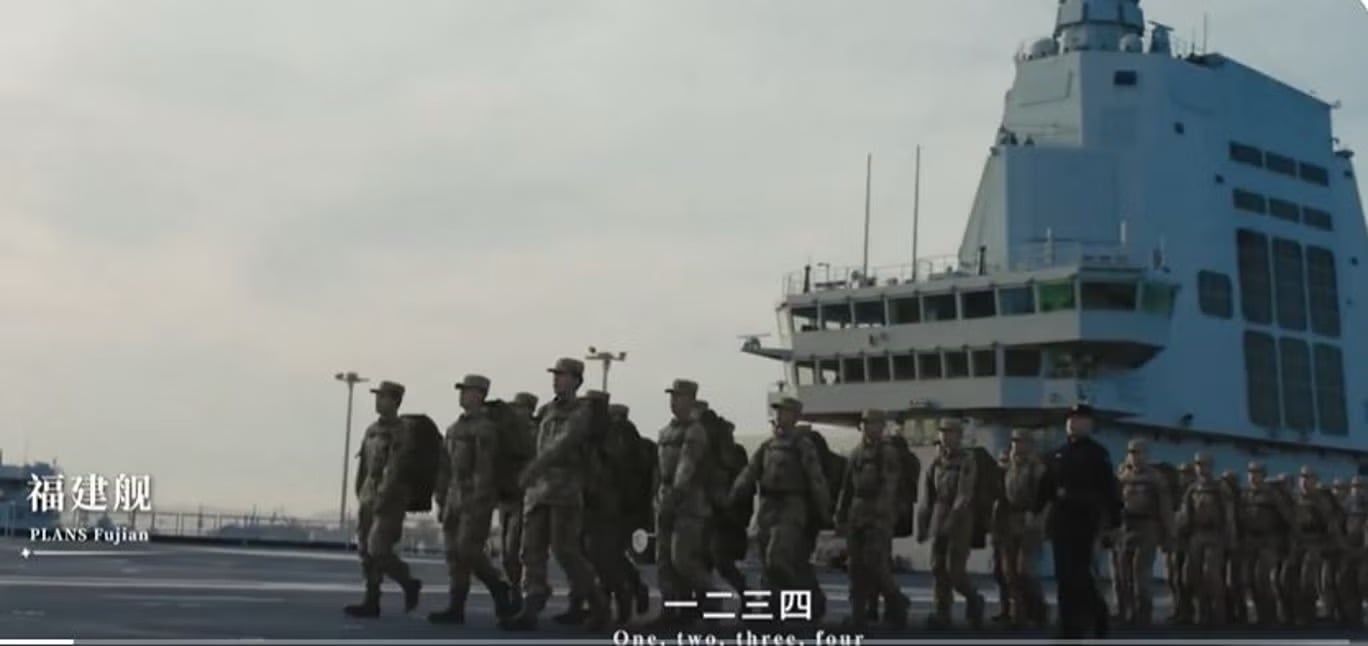
China appears to have used a carefully constructed propaganda video to signal the imminent arrival of its first nuclear-powered aircraft carrier, embedding the revelation in symbolism designed to generate maximum speculation while stopping short of a formal announcement.
The video, released on the eve of the People’s Liberation Army Navy’s 77th anniversary, follows four generations of naval personnel and features a new recruit named “He Jian” — a name that in Mandarin is a homophone for “nuclear vessel.” The three characters representing China’s existing commissioned carriers — the Liaoning, Shandong and Fujian — are each echoed in the names of fictional officers in the film. The recruit’s age, 19, is widely interpreted as pointing toward a fourth carrier bearing pennant number 19, continuing the sequential logic of the current fleet’s numbering: 16, 17 and 18.
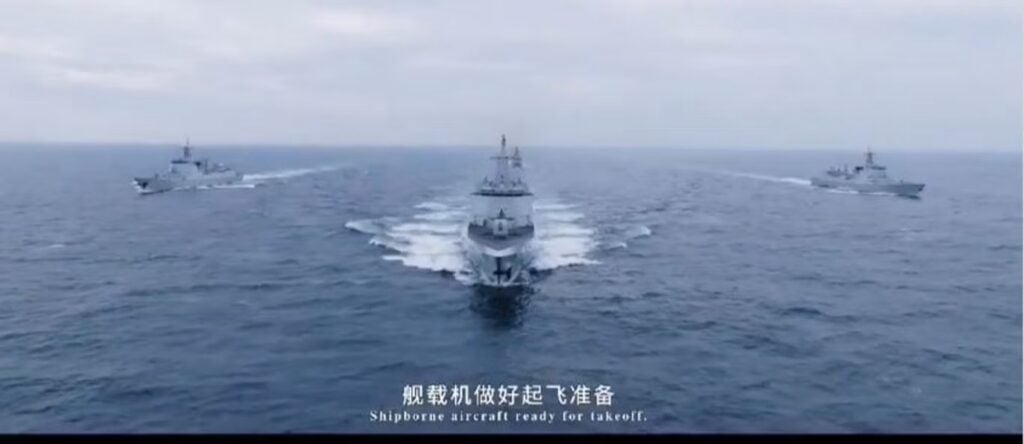
State media outlet Global Times acknowledged the deliberate construction of the film, noting that hidden messages in PLA Navy promotional content had become something of a tradition. The video also contained what observers described as a pointed reference to Taiwan, depicting a naval officer coaxing his son — named “Xiao Wan,” an allusion to Taiwan — to come home. “Mum is waiting for you at home. Let’s go home,” the father tells the reluctant child. Beijing under Xi Jinping has repeatedly refused to rule out the use of force to bring the self-governed island under mainland control and has significantly intensified military activity in surrounding waters in recent years.
The video’s action sequences feature military drills and strike operations across the Pacific, reflecting Beijing’s broader ambitions to develop what military planners call a “bluewater navy” — a fleet capable of projecting power far from Chinese shores. That goal has been central to Xi’s agenda since he assumed leadership of the Communist Party in 2012.
China’s fourth carrier, widely referred to as the Type 004, is believed to be under construction at the Dalian shipyard. According to defence analysts, the vessel is expected to be nuclear-powered, equipped with twin reactors, and capable of displacing between 110,000 and 120,000 tonnes — making it a supercarrier on a par with American vessels. It is anticipated to carry more than 100 aircraft and feature electromagnetic catapult systems capable of launching advanced fighters including the J-35.
A Pentagon report published last December assessed that China aims to operate nine aircraft carriers by 2035, roughly tripling its current fleet at a rate of approximately one new vessel every 20 months. The US Navy currently operates 11 carriers.
The naval expansion is taking place alongside broader Chinese territorial assertiveness. The country’s natural resources ministry has called for greater efforts to “protect” the more than 11,000 islands China claims, the majority of which lie in the East China Sea and South China Sea. China has spent years constructing artificial islands, military installations and airstrips across disputed waters in the region.
