



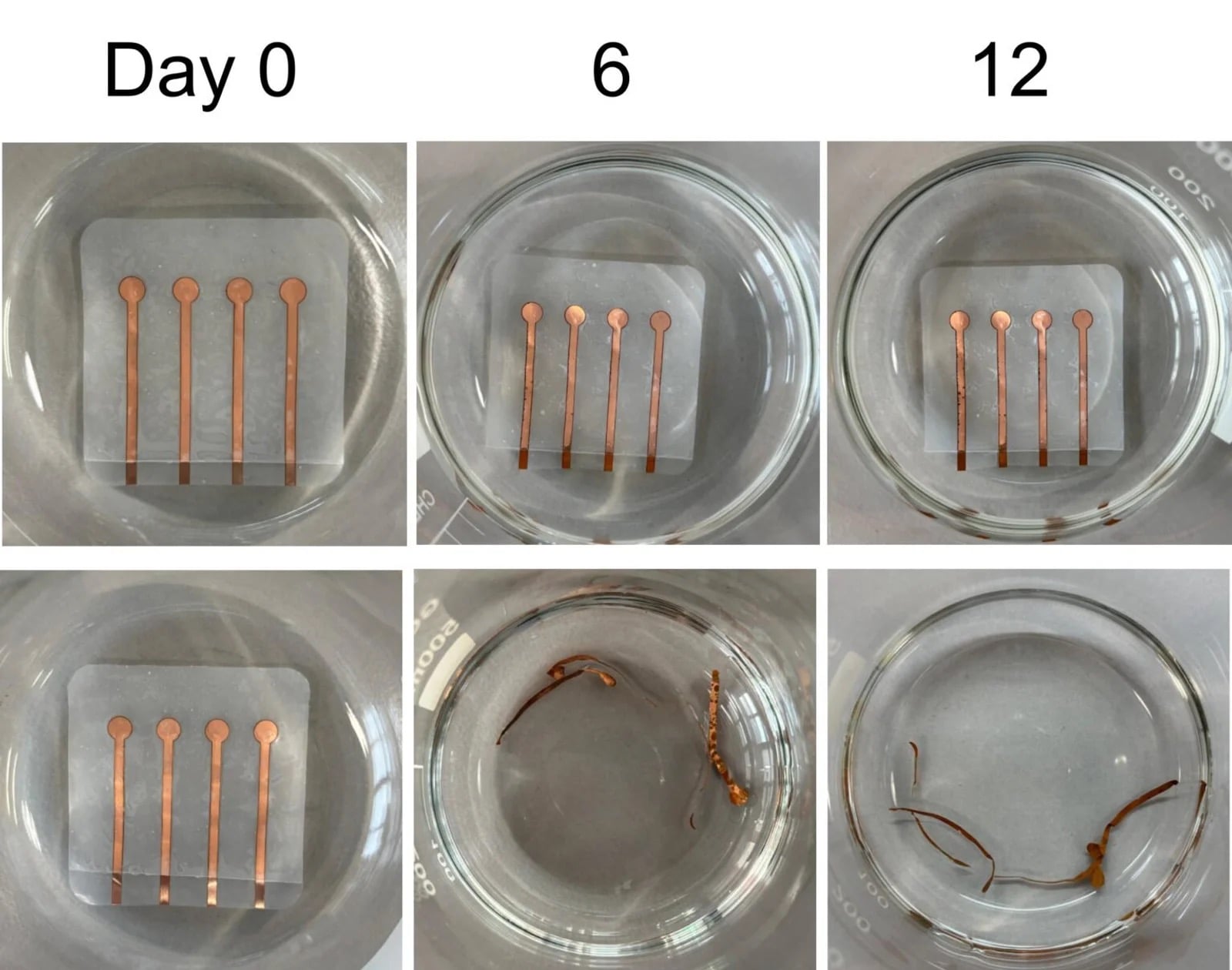
Scientists in China have created a new type of plastic embedded with dormant bacteria that can be triggered to completely destroy itself in less than a week, leaving no trace of microplastics — a development that researchers believe could fundamentally change how the world manages plastic waste.
The breakthrough, published in the journal ACS Applied Polymer Materials, was carried out by researchers at the Shenzhen Institute of Synthetic Biology and represents a significant advance on previous attempts to engineer biodegradable plastics. Rather than relying on a single enzyme — the approach taken in most earlier work — the team embedded two distinct, cooperative bacterial strains into the plastic itself, each targeting a different stage of the breakdown process.
The two engineered strains of Bacillus subtilis work together inside the plastic film. Once triggered, the microbes broke the material down completely in six days, without leaving microplastic particles behind. The first enzyme cuts long polymer chains — the linked molecules that give plastic its structure — into shorter fragments. A second enzyme then processes those fragments into monomers, the most basic molecular units, which can no longer behave like plastic. By splitting the work between two organisms, the team avoided the incomplete breakdown that has often undermined earlier degradation approaches.
To ensure the bacteria remain inert until they are needed, the researchers embedded the microbial spores into the plastic in their dormant state. When placed in a nutrient broth and heated to 50 degrees Celsius, the spores germinate and the breakdown process begins. The plastic used in the study was polycaprolactone, a polymer commonly used in 3D printing and surgical sutures — chosen in part because its chemical structure is well-suited to this enzymatic approach.
As a proof of concept, the team built a wearable plastic electrode from the living material and found it functioned normally — detecting muscle electrical signals — before degrading completely within two weeks under activation conditions. That practical demonstration points toward potential applications in temporary medical sensors and wearable fitness devices, where the ability to programme disposal directly into the product could significantly reduce electronic and plastic waste.
Study author Zhuojun Dai said: “The realisation that traditional plastics persist for centuries, while many applications like packaging are short-lived, led us to ask: could we build degradation directly into the material’s life cycle? By embedding these microbes, plastics could effectively ‘come alive’ and self-destruct on command, turning durability from a problem into a programmable feature.”
The researchers have outlined clear next steps. Future work will focus on developing a water-based activation trigger for the bacterial spores, to address the significant volume of plastic waste that ends up in oceans, lakes and rivers. The team also intends to adapt the dual-enzyme approach for other polymer types, particularly those widely used in single-use packaging — an expansion that could dramatically broaden the technology’s real-world impact.
Plastic pollution remains one of the most pressing environmental challenges on the planet, with conventional plastics capable of persisting in the environment for hundreds of years. The prospect of building programmed degradation directly into a material’s design — rather than attempting to manage it after the fact — marks a potentially significant shift in how scientists and manufacturers approach the problem.
