



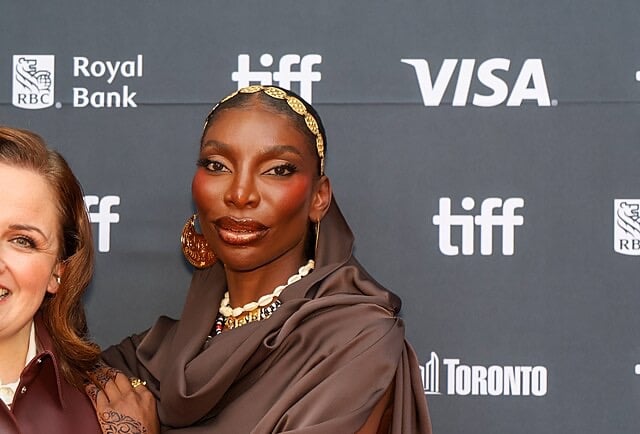
Award-winning actress Michaela Coel has said Britain is no longer the destination it once was for West African migrants, describing the country’s recent anti-immigration protests as “quite odd” and speaking openly about finding greater peace in Ghana than in the nation where she was raised.
The two-time BAFTA winner, who grew up in east London but now divides her time between the capital and her home in Ghana, made the remarks in an interview with The Sunday Times as she prepares to return to screens in the new BBC series First Day on Earth.
Why Britain, Says Coel, Is Losing Its Draw
Coel, 38, recalled watching one of the recent immigration-related protests from her London home, an experience she described as unsettling. “It just seems a bit odd because I don’t think many people are racing to immigrate to the UK like they used to,” she said. “I think more and more, if people can find a way out — I’m talking particularly for West Africans — they will go. I think the UK has lost the attraction it once had.”
Her comments come against a backdrop of increasingly vocal anti-immigration sentiment on British streets. Tommy Robinson’s ‘Unite The Kingdom’ rally in September drew protesters from Stamford Street to the southern end of Whitehall, where crowds raised concerns over free speech and the small boats crisis. Tesla chief executive Elon Musk appeared via a guest video address, urging marchers to “fight back or die” and warning of what he called the “rapidly increasing erosion of Britain.” A second march through the capital is scheduled for next month, with Sharon Osbourne having announced last week that she plans to attend.
Despite her misgivings about the current climate in Britain, Coel remains professionally rooted in the UK. Filming for First Day on Earth — a ten-part BBC series in which she will both star and serve as executive producer — is already under way. It follows a career that has brought her considerable recognition, including Outstanding Writing for a Television Limited Anthology Series or Movie at the Emmys and five BAFTAs for her HBO series I May Destroy You.
The Small Boats Deadlock: A Policy in Disarray
Coel’s remarks land at a moment of acute political sensitivity around immigration. Since Labour came to power, Channel crossings have continued at elevated levels, with an estimated 70,701 migrants making the journey. Approximately 602 people are said to have reached the UK on a single Saturday recently, pushing this year’s running total beyond 6,000.
The government’s attempts to manage the crisis have met with limited results. A bilateral “one in, one out” arrangement with France, under which small boat migrants can be returned across the Channel, has so far seen 377 people removed — while 380 have been brought into the UK under the reciprocal terms of the same deal. The scheme is due to expire in June.
In a further blow to Labour’s credibility on the issue, the head of the UK’s Border Security Command, Martin Hewitt — a former senior police officer appointed by Sir Keir Starmer shortly after he became Prime Minister — stepped down at the end of last month. During his 18 months in post, crossings continued at record-adjacent levels, with last year recording the second-highest annual total since figures began.
Reform’s Hardline Pledge: One Million Deportations
Into this politically charged atmosphere, Reform UK has stepped with its most sweeping immigration proposal to date. Leader Nigel Farage announced that a Reform government would seek to “immediately detain” and deport approximately 400,000 asylum seekers — a figure that, combined with the 600,000 deportations the party outlined last year, would bring the total to one million removals.
Under the proposed policy, all those who arrived illegally in the five years prior to the next general election — whether by small boat, concealed in lorries, or using fraudulent documentation — would be subject to detention and deportation. The party also intends to review all asylum grants issued over the same period, with those whose home countries are now considered safe facing the loss of their status and eligibility for removal. Anyone found to have overstayed a visa before making an asylum claim would face the same outcome.
The practicalities of such a policy present formidable obstacles. The current capacity of immigration removal centres stands at fewer than 3,000 beds — a fraction of the numbers Reform proposes to detain. The party’s spokesman suggested, however, that a significant proportion of those targeted would choose to leave voluntarily rather than face formal removal.
Reform’s home affairs spokesman Zia Yusuf framed the announcement in unambiguous terms. “For years, Tory and Labour governments have presided over an invasion of Britain,” he said. “They have effectively operated an open borders policy. Instead of upholding the law, they have rewarded those who broke it by entering Britain illegally. Reform will reverse this.”
A Country at Odds With Itself
What links Michaela Coel’s personal reflections to the wider political storm is a question that cuts to the heart of contemporary Britain: what kind of country is this, and who does it welcome? For Coel, the answer has become personal enough to shape where she chooses to spend her time. For millions of voters, it remains the defining political question of the moment — and one to which no government has yet offered a convincing answer.
