



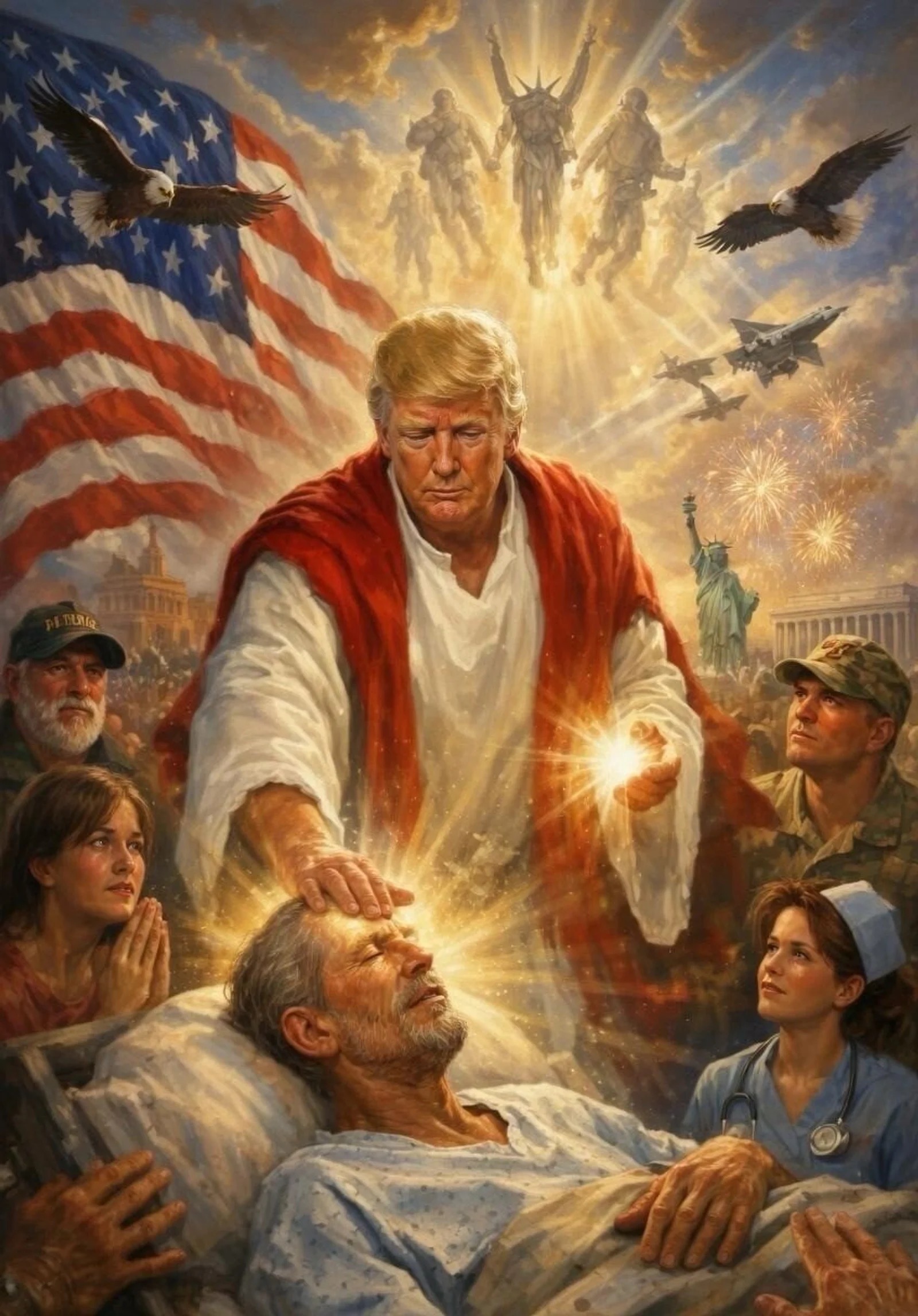
The fractures within Donald Trump’s coalition widened Tuesday when prominent Christian activists who have championed his presidency condemned an AI-generated image the president posted depicting himself in Christ-like imagery healing the sick—a transgression that proved too egregious even for supporters who have defended his most controversial actions throughout his political career.
The now-deleted Truth Social post showed Trump clothed in white robes, hand glowing as he touched the forehead of an ailing hospital patient in visual composition unmistakably evoking religious iconography of Jesus healing the infirm. The background incorporated patriotic imagery including the Statue of Liberty, American flag, fighter jets and an eagle alongside supporting figures of a nurse, praying woman and uniformed soldier—a maximalist blend of messianic and nationalist symbolism that critics across the political spectrum characterised as blasphemous appropriation of sacred Christian imagery.
“This should be deleted immediately,” wrote Sean Feucht, a Christian activist collaborating with the administration on faith-based events marking America’s 250th anniversary this year. “There’s no context where this is acceptable.” Riley Gaines, a prominent conservative activist, invoked biblical warning that “God shall not be mocked,” whilst David Brody of the Christian Broadcasting Network declared flatly: “This goes too far. It crosses the line. A supporter can back the mission and reject this.”
The swift condemnation from figures considered close to Trump and his administration revealed limits to the latitude Christian conservatives will extend a president they view as flawed instrument for advancing their policy objectives. Whereas previous controversies saw evangelical leaders offer theological justifications for supporting Trump despite personal conduct they would condemn in others, the messianic self-portrayal apparently crossed boundaries that pragmatic alliance cannot accommodate—suggesting even transactional religious support requires maintaining distinction between political leadership and divine authority.
What Trump’s Defence Reveals About His Relationship With Religious Imagery
Speaking to reporters hours after removing the image, Trump insisted he believed it depicted him “as a doctor next to a Red Cross worker” rather than religious figure. “It’s supposed to be as a doctor making people better,” he stated. “And I do make people better. I make people a lot better.” The explanation strained credulity given the visual composition’s unmistakable religious references, raising questions about whether Trump genuinely failed to recognise the Christ imagery or simply refused to acknowledge its obviously blasphemous nature.
The president’s apparent inability or unwillingness to distinguish between medical professional and messianic healer—or to recognise why Christian supporters might object to such conflation—illuminates the complicated relationship between Trump and the religious constituencies whose votes proved essential to his political success. Evangelical leaders have repeatedly characterised Trump as imperfect vessel through which God works to advance conservative policy objectives, a theological framework permitting support despite personal conduct contradicting professed Christian values.
Yet the messianic imagery crossed from imperfect-vessel narrative into territory suggesting Trump himself possesses divine healing powers—a claim that even the most flexible theological rationalisation cannot accommodate without abandoning core Christian doctrine reserving such attributes exclusively for Christ. That Trump posted the image less than an hour after attacking Pope Leo XIV for criticising the Iran war suggests either remarkable tone-deafness about religious sensibilities or deliberate provocation testing how far his Christian base will follow when he challenges ecclesiastical authority.
The Pope Confrontation That Preceded the Deleted Image
Trump’s separate Truth Social post condemning Pope Leo as “weak on crime” and “terrible for foreign policy” established context making the subsequent messianic self-portrayal appear less like isolated misjudgment than calculated assertion of authority superseding papal criticism. Leo XIV—the first American Pope—has “repeatedly condemned the war in Iran, saying it has led to ‘absurd and inhuman violence,'” positioning himself as moral voice challenging American military action that Trump characterises as necessary to prevent Iranian nuclear weapons development.
The pontiff’s declaration Monday that he has “no fear” of the Trump administration or “speaking out loudly of the message of the Gospel, which is what I believe I am here to do” established direct confrontation between presidential and papal authority that the messianic imagery appeared designed to resolve through visual assertion that Trump himself possesses spiritual authority rivalling or exceeding Leo’s institutional position.
“Pope Leo said things that are wrong,” Trump told reporters, refusing to apologise whilst insisting the pontiff “was very much against what I’m doing with regard to Iran, and you cannot have a nuclear Iran. Pope Leo would not be happy with the end result.” The framing positioned papal moral objections as misguided interference in strategic decisions requiring worldly rather than spiritual wisdom—a stance that Christian conservatives might accept regarding policy disagreements yet which the messianic imagery transformed into apparent claim of competing divine authority that even Trump’s staunchest religious allies could not defend.
Why This Episode Fits Pattern of Controversial Social Media Conduct
The AI-generated messianic portrait represents latest in series of Truth Social posts that have generated fierce backlash forcing removal and damage control. In February, a racist clip depicting Barack and Michelle Obama as apes appeared on Trump’s account before being deleted following condemnation including from Republican senators. The White House initially defended that post as “internet meme video” whilst telling critics to “stop the fake outrage,” yet eventually removed it claiming a staffer had “erroneously” published the content.
The pattern suggests either inadequate vetting of material before posting or deliberate strategy of pushing boundaries through provocative content that generates attention whilst maintaining plausible deniability through subsequent removal and blame-shifting to subordinates. The messianic image’s swift deletion following Christian conservative backlash indicates recognition that certain transgressions cannot be defended even through the aggressive counter-attack and claims of victimisation that typically characterise Trump’s response to criticism.
Yet the president’s refusal to apologise—instead insisting the image showed him as doctor who does “make people better”—demonstrates the limits of whatever chastening the episode produced. Trump appears to have concluded that removing offensive content represents sufficient concession without requiring acknowledgment that posting it constituted error requiring contrition or commitment to avoiding similar misjudgments.
For Christian conservatives who have invested substantial political and moral capital defending Trump’s presidency despite mounting evidence that his conduct contradicts values they claim to hold sacred, the messianic imagery forced moment of reckoning about whether their alliance requires accepting blasphemous self-deification or whether some boundaries remain inviolate regardless of policy alignment. The swift condemnation from figures like Feucht, Gaines and Brody suggests that explicitly appropriating Christ’s role crosses lines that even the most pragmatic religious support cannot accommodate—a rare instance where Trump’s base imposed limits that forced retreat rather than doubling down on provocation.
Whether the episode produces lasting damage to Trump’s relationship with Christian conservatives or proves merely temporary embarrassment that fades as policy priorities reassert themselves depends partly on whether similar incidents recur and partly on how effectively evangelical leaders can explain to congregations why they continue supporting a president whose self-portrayal as divine healer they themselves condemned as unacceptable blasphemy.
