



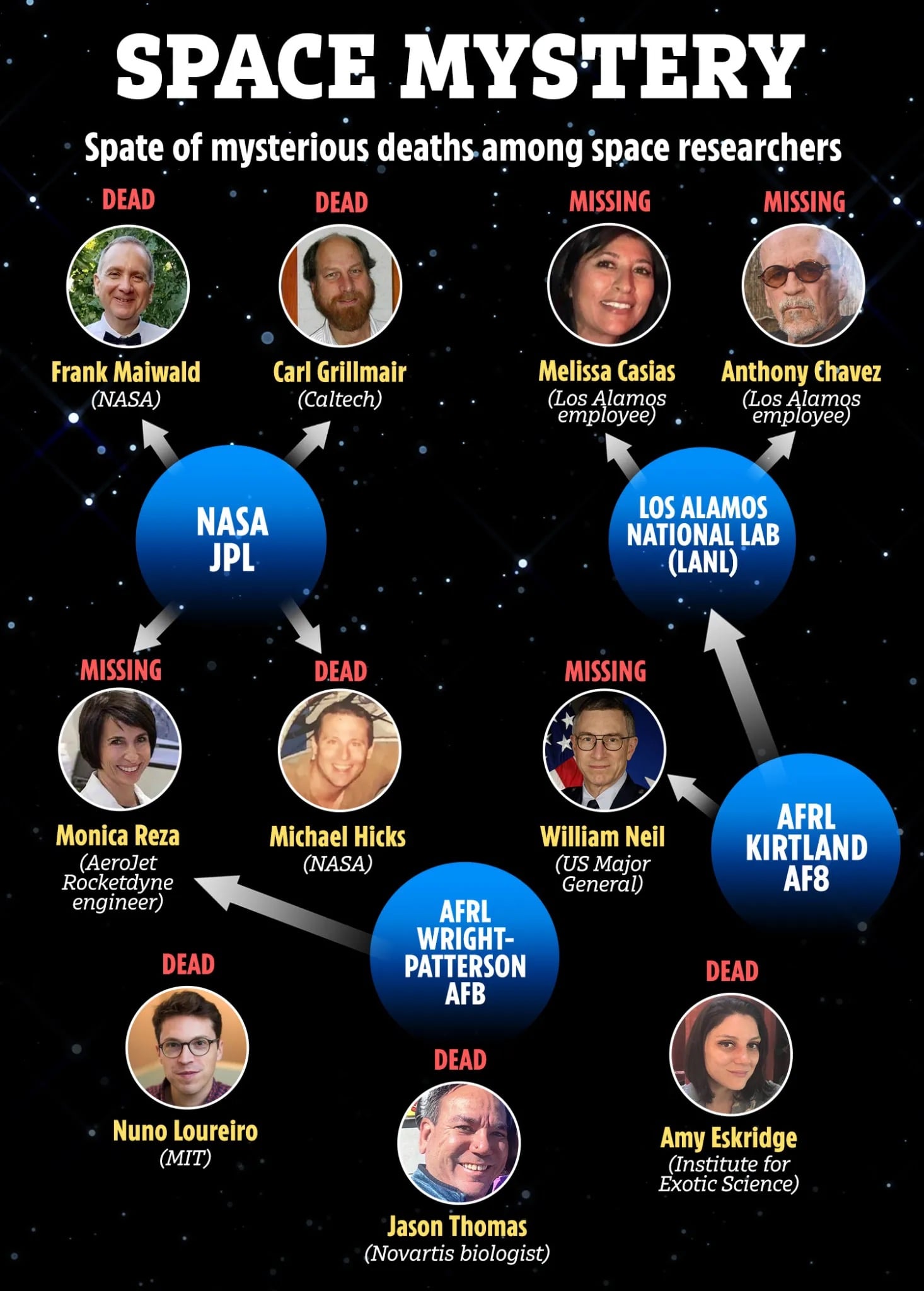
President Donald Trump has promised to determine within days whether the deaths or disappearances of eleven individuals connected to American space and nuclear programmes represent “random” coincidence or coordinated targeting—an extraordinary presidential intervention into cases that have fuelled conspiracy theories linking anti-gravity research, UFO secrecy, and alleged assassination campaigns against scientists possessing sensitive government knowledge.
“I hope it’s random, but we’re going to know in the next week and a half,” Trump stated Thursday following what he described as a “top secret meeting” on the topic. “Pretty serious stuff… hopefully a coincidence, or whatever you want to call it. Some of them were very important people, and we’re going to look at it over the next short period.”
The presidential commitment to provide answers represents dramatic escalation of what began as fringe speculation about whether scientist deaths occurring between 2022 and 2026 constituted pattern requiring federal investigation. White House press secretary Karoline Leavitt acknowledged earlier this week that “if true, of course, that’s definitely something I think this government, administration would deem work worth looking into”—a conditional formulation suggesting official scepticism about whether the cases merit treatment as coordinated conspiracy rather than statistical clustering of unrelated tragedies.
The eleven individuals whose fates have generated scrutiny include researchers affiliated with NASA, Los Alamos National Laboratory, MIT and Caltech—institutions at the forefront of American space exploration, nuclear weapons development, and advanced physics research. Yet the diversity of their specialisations, geographic locations, and circumstances surrounding their deaths or disappearances complicates efforts to identify common threads beyond their general connection to cutting-edge scientific programmes.
What Amy Eskridge’s 2020 Warning Suggested About Threats She Perceived
Amy Eskridge, the 34-year-old physicist found dead from apparent self-inflicted gunshot wound in Huntsville, Alabama on 11 June 2022, has become focal point for conspiracy theories given her pre-death statements warning that her anti-gravity technology research placed her life in danger. Neither police nor medical examiners have publicly released investigation details—an opacity that theorists cite as evidence of cover-up despite such reticence being routine in suicide cases where families request privacy.
In a 2020 podcast interview that has recently resurfaced, Eskridge explained why she co-founded The Institute for Exotic Science with her father Richard, a retired NASA engineer: to create “public-facing persona to disclose anti-gravity technology” operating independently from government oversight. “If you stick your neck out in public, at least someone notices if your head gets chopped off,” she stated. “If you stick your neck out in private they will bury you, they will burn down your house while you’re sleeping in your bed and it won’t even make the news. That’s why the institute exists.”
Before her death, Eskridge contacted retired British intelligence officer Franc Milburn for assistance investigating what she characterised as harassment including physical attacks involving “energy weapons”—claims that Milburn subsequently amplified through public testimony yet which have never been corroborated through medical documentation, forensic analysis, or independent witness verification that conventional investigation standards would demand.
Journalist Michael Shellenberger testified at a public hearing months after Eskridge’s death that she was “murdered by a private aerospace company”—an allegation specific enough to constitute actionable claim yet vague enough to avoid identifying which company allegedly bore responsibility or what evidence supported the murder determination beyond official suicide classification.
The Solved Homicides That Undermine Coordinated Assassination Theories
Of the eleven deaths and disappearances generating concern, two involved clear homicides where perpetrators have been identified and charged—a reality that substantially complicates narratives about shadowy government or corporate elimination programmes targeting scientists whose knowledge threatened powerful interests.
MIT physics professor Nuno Loureiro, 47, was shot dead in his Brookline, Massachusetts home on 15 December 2025. Authorities charged Claudio Neves Valente, identified as Loureiro’s former Portuguese classmate, with the murder alongside a separate shooting at Brown University two days earlier. Whilst conspiracy theorists speculate that Loureiro’s revolutionary work in nuclear fusion plasma physics made him target of broader plot, police have provided no indication that motives extended beyond personal grievances that prompted Valente to travel from Portugal to execute the attack.
Caltech astrophysicist Carl Grillmair, 67, was gunned down at his California home on 16 February 2026 in what authorities characterised as unprovoked attack. Police identified and charged Freddy Snyder, 29, with murder, carjacking and burglary—conventional criminal charges suggesting opportunistic violence rather than targeted assassination related to Grillmair’s work on NASA telescope projects tracking asteroids using physics applicable to military satellite surveillance systems.
That two of the most prominent deaths involved identified perpetrators facing prosecution substantially undermines claims of coordinated elimination campaign: professional assassins conducting government-sanctioned operations typically avoid leaving evidence permitting swift identification and arrest, whilst the conventional criminal charges Snyder faces suggest standard violent crime rather than sophisticated intelligence operation.
The Unexplained Deaths and Disappearances That Fuel Speculation
Jason Thomas, a pharmaceutical researcher testing cancer treatments at Novartis, was found dead face-down in a Massachusetts lake in March 2026 after disappearing three months earlier. Local police stated his death was not the result of foul play—an assessment that if accurate would classify the incident as tragic accident or suicide unrelated to professional work despite the timing relative to other scientist deaths.
NASA Jet Propulsion Laboratory scientists Michael David Hicks and Frank Maiwald both died from undisclosed causes—Maiwald at 61 whilst serving as lead researcher on breakthrough project detecting extraterrestrial life signatures, and Hicks at 59 shortly after leaving NASA’s DART Project testing asteroid deflection capabilities. NASA has not commented on either death nor disclosed circumstances surrounding their passing, creating information vacuum that speculation readily fills.
The missing persons cases prove equally opaque. Retired Air Force General William Neil McCasland, 68, vanished during a New Mexico hike on 27 February 2026 despite extensive searches employing drones, helicopters, ground crews and K-9 units. Sources described McCasland as “gatekeeper and participant” in UFO community whilst investigative journalist Ross Coulthart characterised him as “a man with some of the most sensitive secrets of the United States head”—formulations suggesting knowledge that powerful interests might wish to suppress yet providing no concrete evidence that his disappearance involved foul play rather than hiking accident in terrain where bodies can remain undiscovered indefinitely.
Monica Reza, 60, a material scientist who collaborated with McCasland on rocket projects, disappeared during a June 2025 hike in California. The coincidental similarity between her disappearance and McCasland’s—both vanishing whilst hiking despite their professional connections—generates speculation about coordination yet proves equally consistent with tragic accidents befalling individuals who pursued outdoor recreation in remote areas where search-and-rescue operations frequently prove unsuccessful.
Why Trump’s Investigation Timeline and UFO Disclosure Promises Matter
The president’s commitment to provide answers within “week and a half” establishes extraordinarily compressed timeline for investigating cases spanning four years across multiple jurisdictions involving local police, coroners, federal agencies, and private institutions. Whether meaningful conclusions can emerge from such rushed examination or whether Trump merely seeks to demonstrate responsiveness to conspiracy theory constituents remains subject to speculation.
The investigation announcement arrives amid Trump’s broader promise to “begin the process of identifying and releasing” government files on aliens and extraterrestrial life—a commitment that connects scientist death theories to UFO disclosure narratives suggesting that suppressed knowledge about non-human technology drives elimination of researchers who threaten to expose secrets that shadowy elements within government or aerospace industry wish to protect.
Yet the practical challenges confronting any genuine investigation prove substantial. Local jurisdictions retain authority over homicide and missing person cases occurring within their boundaries, limiting federal capacity to override determinations that deaths resulted from suicide, accident, or conventional crime. Medical examiners’ conclusions about causes of death depend on physical evidence and autopsy findings that presidential pressure cannot retroactively alter if documentation supports official classifications.
The diversity of circumstances—two solved homicides with identified perpetrators, apparent suicide, accidental drowning, unexplained deaths from undisclosed causes, hiking disappearances in remote terrain—resists synthesis into coherent pattern suggesting coordinated elimination. If government or corporate actors systematically targeted scientists, the operational sophistication required to execute eleven separate incidents across four years whilst avoiding detection would be extraordinary yet the actual cases include multiple instances where conventional explanations prove entirely adequate.
Trump’s characterisation of the investigation as examining whether deaths prove “random” or represent something more sinister establishes false binary: the cases could be neither purely random nor coordinated conspiracy but rather collection of unrelated tragedies, conventional crimes, and accidents that conspiracy theorists have assembled into narrative through selective emphasis on victims’ professional connections whilst ignoring base rates suggesting that amongst thousands of scientists working on space and nuclear programmes, eleven deaths or disappearances over four years may not significantly exceed expected mortality and missing person rates.
Whether the promised “week and a half” investigation produces evidence of coordinated targeting, concludes that coincidence adequately explains the pattern, or merely generates additional speculation that neither confirms nor refutes conspiracy theories will substantially affect how these cases enter public consciousness. For now, Trump’s intervention transforms what began as fringe speculation into matter receiving presidential attention—an elevation that simultaneously validates concerns driving the theories whilst potentially subjecting them to scrutiny they may prove unable to withstand once federal resources examine whether evidence supports the dramatic claims that social media amplification has transformed from isolated allegations into narrative demanding official response.
