



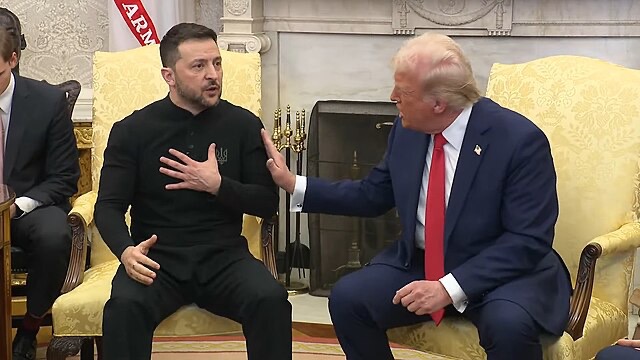
Ukrainian President Volodymyr Zelenskyy has publicly offered to assist the United States in countering Iranian drone threats in the Middle East, drawing on Kyiv’s extensive battlefield experience fighting Tehran-supplied Shahed drones during Russia’s ongoing invasion — only to be rebuffed by President Donald Trump.
Speaking in a series of international media interviews on Monday, Zelenskyy said Ukraine had already dispatched teams of drone experts to the Middle East and stood ready to do more. He told the New York Post that Ukraine “reacted immediately” when the United States launched operations against Iran, adding that wherever it was possible to help defend civilians or American personnel, Ukraine had sent its teams “without second thought.”
Zelenskyy framed the offer in broader terms, pushing back against any perception of Ukraine as solely a recipient of Western aid. “I would like the U.S. not to perceive Ukraine as a country that merely asks for help,” he wrote on X. “Ukraine is defending interests and values.” He argued that Ukraine’s years of experience intercepting and analysing Iranian-designed Shahed drones had made the country uniquely placed to assist allied forces. “Ukraine was kind of an experiment place for these drones,” he told The Jerusalem Post, noting the significant technological evolution of the Shahed between the start of the war and today.
Going further, Zelenskyy proposed a joint manufacturing initiative, suggesting Ukraine and the United States could together build what he described as “the world’s biggest drone factory” — with the US providing production capacity and financing, and Ukraine contributing technology and operational experience developed on the battlefield.
Trump, however, dismissed the overture. “We don’t need help,” the President told NBC News on Saturday. “The last person we need help from is Zelenskyy.”
The offer came as Trump had separately called on allied nations including the UK, France, Japan, South Korea, China and Australia to send ships to help protect commercial shipping through the Strait of Hormuz. Several countries, including Australia, Japan and Italy, have reportedly declined to participate while the conflict remains active.
Zelenskyy acknowledged the geographic distance between the United States and the European theatre but said Ukraine could clearly see what — and who — was threatening American allies in the Middle East. Whether his offer of drone expertise will be revisited by Washington as the conflict develops remains to be seen.
