



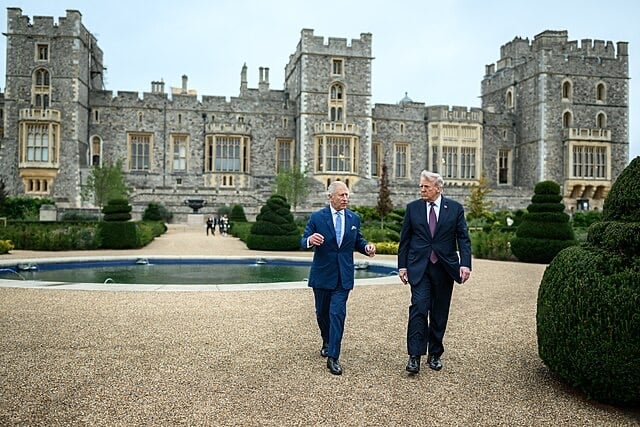
President Donald Trump has sought to exploit tensions within Britain’s constitutional framework by claiming King Charles would have adopted a markedly different position on the Iran conflict than the Prime Minister, in what observers characterise as an attempt to undermine Sir Keir Starmer’s refusal to join American military operations.
The extraordinary intervention came during a Telegraph interview where Mr Trump praised His Majesty as “a friend of mine” and “a great gentleman” before suggesting the monarch would have “taken a very different stand” from the Government’s position—a claim that breaches constitutional conventions preventing the sovereign from political involvement.
“I like him. I always liked him as a prince. He’s a good man, a great representative for your country,” Mr Trump stated, adding: “I think he would have taken a very different stand (on the war in Iran), but he doesn’t do that.”
The remarks arrive as Buckingham Palace confirmed the King and Queen’s late April State Visit will proceed despite pressure to postpone, with Mr Trump declaring via Truth Social the four-day engagement from 27-30 April will be “TERRIFIC!” and include “a beautiful Banquet Dinner” at the White House on 28 April.
Liberal Democrats leader Sir Ed Davey condemned the visit’s continuation, accusing Sir Keir of displaying a “staggering lack of backbone” whilst Mr Trump treats Britain with contempt.
However, the President insisted his relationship with the monarch remains separate from deteriorating government-to-government relations. “He’s a wonderful and brave man, to be honest with you. He’s been through a lot, in many ways,” Mr Trump stated, emphasising King Charles had “nothing to do with this” regarding the breakdown in Anglo-American relations over Iran.
The comments expose Washington’s fury at European allies’ refusal to engage in offensive Iranian operations, with Mr Trump telling the Telegraph he is considering American NATO withdrawal in response to perceived abandonment.
US Defence Secretary Pete Hegseth separately attacked Britain’s maritime capabilities, stating: “Last time I checked there was supposed to be a big, bad Royal Navy” whilst criticising London’s failure to dispatch warships for Strait of Hormuz operations.
Sir Keir responded on Wednesday by pledging to act in British national interest “whatever the pressure on me and others, whatever the noise,” refusing to be drawn into Mr Trump’s apparent attempt to create daylight between Government policy and royal preferences.
Constitutional experts note the King’s views on military intervention remain strictly private, with any suggestion he would publicly contradict elected government position representing fundamental misunderstanding—or deliberate misrepresentation—of Britain’s constitutional monarchy principles.
The President’s long-standing Royal Family admiration was evident in last year’s second State Visit invitation, widely interpreted as governmental attempt to placate Washington, though current tensions suggest that diplomatic investment has yielded limited returns as transatlantic relations reach their lowest point in recent memory.
