



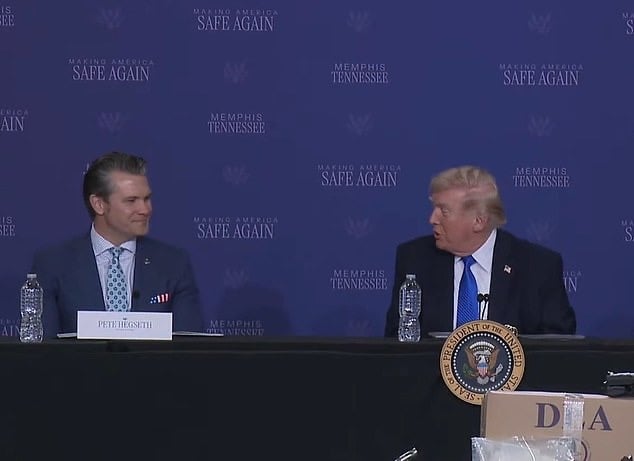
Donald Trump appeared to suggest his Secretary of War Pete Hegseth was among the first to advocate for striking Iran, in remarks at a Tennessee conference on Monday that drew an awkward reaction from the defence secretary sitting beside him.
Recounting the discussions that preceded the military campaign, Trump described gathering senior advisers to address Iran’s nuclear ambitions before turning to Hegseth directly. “Pete, I think you were the first one to speak up. And you said, ‘Let’s do it, because you can’t let them have a nuclear weapon,'” the President told the audience. Hegseth responded with a forced smile as Trump moved on to discuss ongoing talks with Tehran.
Trump claimed negotiations with Iran had “started last night” and expressed cautious optimism, saying there was “a very good chance” of a resolution and that Iran had agreed it would not pursue nuclear weapons. He also praised Israel as “a great partner in this fight.”
The comments came as the conflict entered its fourth week and the economic consequences of the Strait of Hormuz closure continued to mount. The International Energy Agency’s chief Fatih Birol delivered a stark assessment at Australia’s National Press Club, warning that the global economy faced a “major, major threat” and that “no country will be immune” if the situation continued. He compared the current energy crisis to the oil shocks of the 1970s and the disruption caused by Russia’s 2022 invasion of Ukraine, noting that at least 40 energy assets across nine countries in the region had been severely damaged.
Iran has effectively controlled access to the Strait since the US and Israel launched operations on 28 February, restricting passage to countries it considers allied. Around 20 per cent of the world’s oil and liquefied natural gas passes through the waterway, and Austrian researchers have estimated that exports worth up to $1.2 trillion could be affected if the closure persists. Their findings identified the UK as having the greatest exposure to supply chain disruption of any country in Europe, importing $12 billion worth of goods through the Strait annually, including $5.9 billion in Qatari LNG and propane alone.
Dr Jasper Verschuur of Delft University of Technology told the Daily Mail that what made the situation particularly acute was that “there are no alternatives to reroute goods” — leaving Britain with a genuine vulnerability in its energy supply that cannot be quickly substituted.
Trump had issued a 48-hour ultimatum over the weekend threatening to strike Iranian power plants if the Strait was not reopened, before announcing on Monday a five-day pause in those specific strikes following what he described as productive conversations with Tehran. Iran denied any talks had taken place. US military operations against other Iranian targets have continued during the pause.
Trump also suggested he could jointly oversee management of the Strait alongside Iran’s next supreme leader once a deal was reached, saying control could fall to “me and… whoever the next ayatollah is.”
Hegseth, meanwhile, used recent public appearances to defend the war’s conduct, attacking what he called “ungrateful allies in Europe” and claiming the world should be telling Trump “thank you.” Both he and other cabinet members have seen their public approval ratings fall in recent weeks as the conflict’s economic toll has deepened.
