



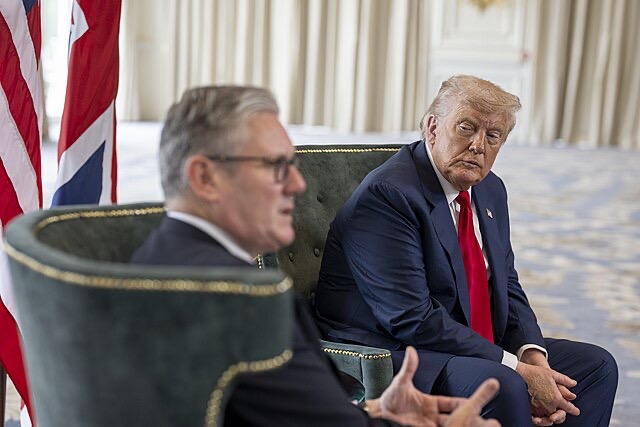
Sir Keir Starmer has mounted a robust defence of NATO following President Donald Trump’s revelation he is “strongly considering” withdrawing the United States from the transatlantic alliance over European allies’ refusal to join military operations against Iran.
The Prime Minister told a Downing Street briefing on Monday that NATO represents “the single most effective military alliance the world has ever seen” which “has kept us safe for many decades,” affirming Britain remains “fully committed” to the organisation regardless of American participation.
Sir Keir’s intervention came hours after Mr Trump disclosed to The Telegraph he had always known the 75-year-old defensive pact was a “paper tiger”—an extraordinary characterisation of an alliance Washington founded in 1949 alongside Britain and ten other nations.
The President has repeatedly castigated European NATO members throughout the Iran conflict for declining to provide military support to American operations, telling an audience in Miami last week: “They made a big mistake, they were not there.”
His threat to abandon the alliance marks the most explicit declaration yet that Washington may terminate collective defence commitments enshrined in NATO’s Article 5, which treats an attack on one member as an attack on all.
Sir Keir emphasised that “whatever the pressure” applied to him and fellow national leaders, he would prioritise the “national interest” above American demands, reiterating Britain’s position of providing only defensive assistance to regional allies whilst refusing participation in offensive strikes against Iranian territory.
The Prime Minister’s calculated response walks a diplomatic tightrope between defending an alliance structure Britain considers fundamental to European security and avoiding further antagonising a president who has already threatened trade consequences, dismissed British military capabilities as inadequate, and demanded London independently secure energy supplies.
Mr Trump’s NATO withdrawal threat represents escalation beyond previous complaints about burden-sharing and defence spending, which he successfully leveraged to pressure members into doubling military budgets from 2 per cent to the proposed 5 per cent GDP threshold.
European capitals now confront the possibility America may formally abandon collective defence obligations that have underpinned Western security architecture since the Second World War’s aftermath—a scenario previously considered unthinkable despite Mr Trump’s notorious scepticism about alliance value.
The timing coincides with NHS warnings that critical medical supplies may be exhausted within days due to shipping disruption from Iran’s Strait of Hormuz blockade, intensifying domestic pressure on the Government to address the conflict’s economic consequences whilst maintaining strategic distance from American military operations.
