



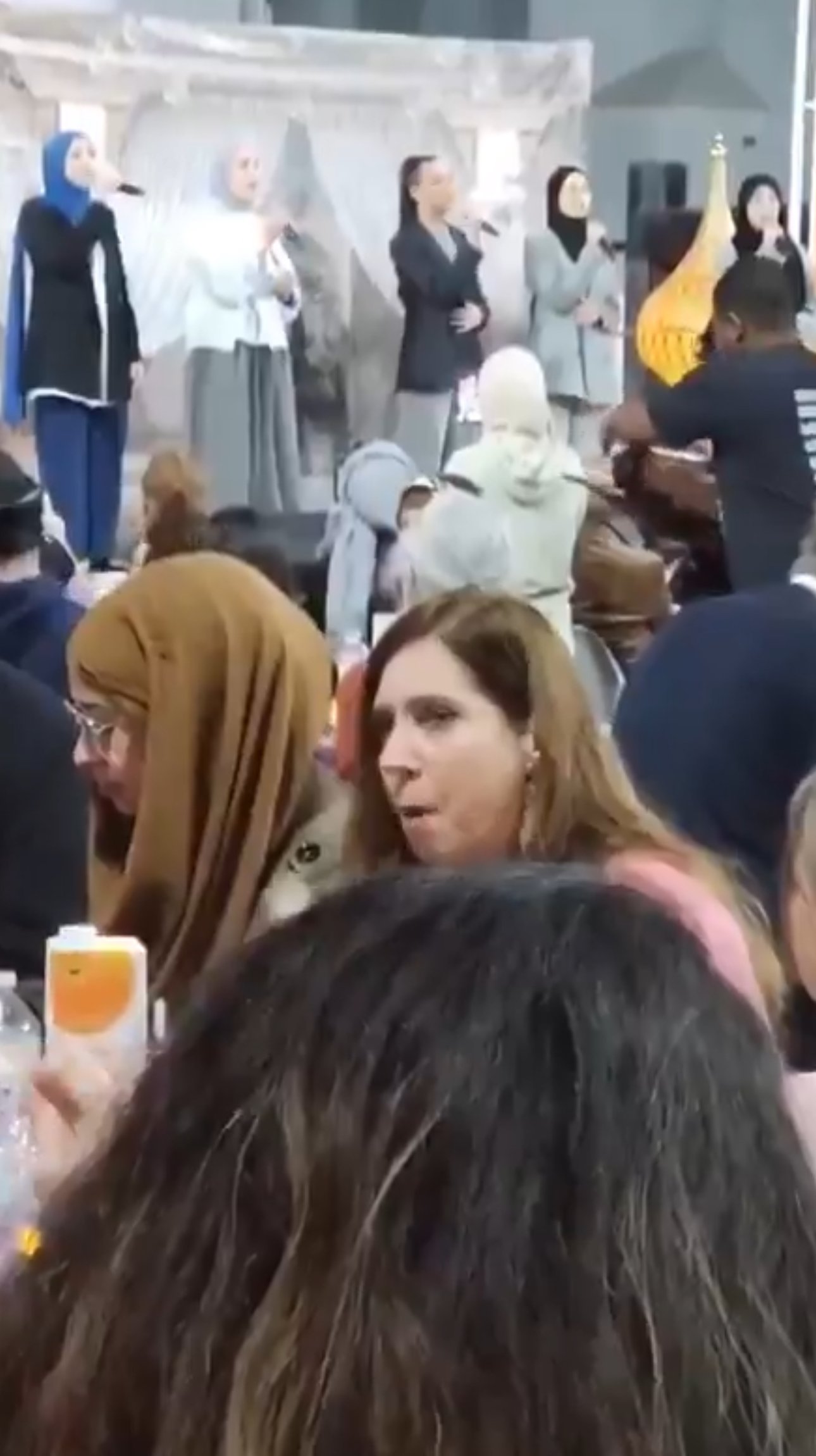
Video footage recorded in February 2026 shows young women in hijabs singing the Islamic declaration of faith “There is no god but Allah” inside Saint-Jean-Baptiste Catholic Church in Molenbeek, Brussels during this year’s Ramadan, marking the second consecutive year the church has hosted such an interfaith Iftar event.
The February 2026 incident follows a previous gathering on 23 March 2025 when the Art Deco-style Lasallian-run church first hosted a Ramadan fast-breaking meal attended by over 500 people from diverse backgrounds. The church has now permitted similar events during Ramadan for two years running.
Both events were organized by Molenbeek for Brussels 2030 with local partners as part of the commune’s bid for European Capital of Culture 2030. During this year’s shared meal held within the Catholic church, young women recited and sang the Shahada, the Islamic declaration stating “There is no god but Allah,” sometimes extending the invocation with full praises of Allah’s oneness and power.
The church has permitted the gatherings during both Lent and Ramadan in consecutive years. Critics have highlighted what they describe as a clear double standard in religious respect, arguing Christians would never be permitted to sing declarations about Jesus Christ inside a mosque.
The video footage from the February 2026 event showing hijab-wearing women singing the Islamic declaration inside the church has circulated online this year, prompting renewed debate about appropriate boundaries in interfaith events. The declaration “There is no god but Allah” represents the first part of the Shahada, Islam’s fundamental statement of monotheistic faith.
The repeat occurrence of Islamic religious declarations being sung inside the Catholic church across two consecutive Ramadan periods suggests the practice has become an established element of the annual interfaith Iftar hosted by Saint-Jean-Baptiste church. The 2025 event attracted over 500 attendees representing Molenbeek’s diverse population.
The events aim to promote multiculturalism, inclusion and solidarity in Molenbeek, a district housing 140 nationalities. The commune’s bid for European Capital of Culture 2030 has emphasized diversity and interfaith cooperation as central themes, with the annual Iftar gatherings demonstrating this commitment.
The Saint-Jean-Baptiste church’s decision to host the Iftar during Lent for a second consecutive year represents continued interfaith accommodation, with Catholic authorities again permitting the gathering during one of Christianity’s most sacred periods. The timing of both Lent and Ramadan overlapping has provided the context for the joint celebrations in both 2025 and 2026.
Local partners collaborated on organizing both gatherings, which combine the Islamic tradition of breaking fast together during Ramadan with the Catholic practice of opening church spaces for community events. The Molenbeek for Brussels 2030 organization has positioned the repeat events as demonstrating the area’s sustained commitment to intercultural dialogue.
The European Capital of Culture bid will be decided by evaluators assessing Molenbeek’s cultural programming and vision. The annual interfaith Iftar events form part of the commune’s demonstration of its multicultural character and ability to bring diverse communities together over multiple years.
The emergence of video footage from this year’s February 2026 event has reignited discussions about reciprocity in interfaith tolerance that first surfaced following the 2025 gathering. Critics pointing to the double standard argue that equivalent Christian religious declarations would not be welcomed in Islamic spaces, with the repetition of the practice across two years intensifying concerns.
The establishment of an annual pattern suggests similar events may continue in future years as part of the ongoing Capital of Culture bid campaign. The reaction to Islamic declarations being sung inside the Catholic church for a second consecutive year may influence decisions about whether the format continues or if boundaries around religious expressions in interfaith cooperation need reconsideration.
The Molenbeek for Brussels 2030 organization has not commented on the renewed criticism regarding double standards raised by observers since the February 2026 video emerged. The continuation of the practice into a second year despite previous criticism suggests organizers view the interfaith expression as compatible with the church’s mission and the Cultural Capital bid’s objectives.
