



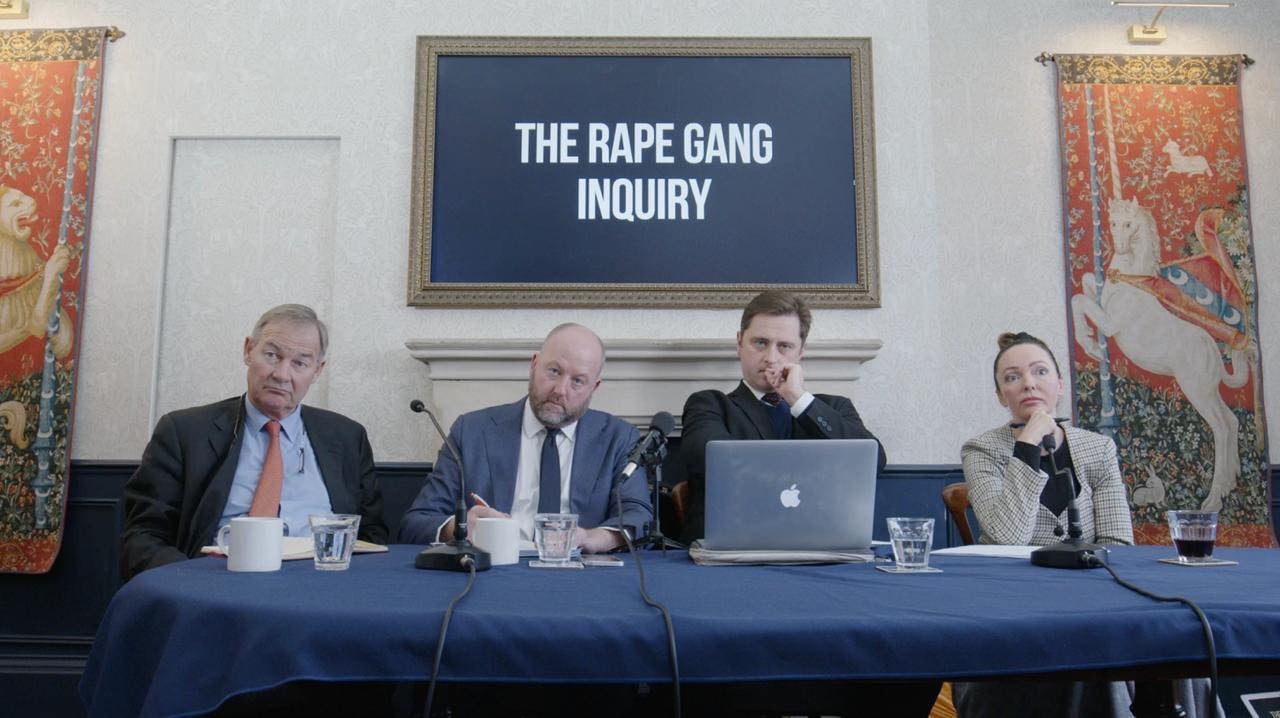
An independent inquiry into rape and grooming gangs is currently running in early February 2026 with hearings scheduled over a ten-working-day period in central London, launched by a single MP after he claimed official promises of an inquiry had not been delivered.
Rupert Lowe, who established the inquiry through crowdfunding that raised over £600,000 from around 20,000 donors, took to Facebook to answer a question asked by many: “Which parties have supported the rape gang inquiry efforts?”
His response revealed stark divisions in political support for the investigation into gang-based child sexual exploitation across Britain.
Conservative Party Support
Lowe stated: “A reasonable number of Conservatives have contributed – attending our survivor event, speaking to the hearings and backing our parliamentary efforts. Particularly Esther McVey who is an absolute hero.”
However, he added anger at recent comments from party leadership: “Although the Tory chairman this morning said our inquiry was a ‘distraction’, which I am incredibly angry about. What an insult that is.”
Labour Party Support
According to Lowe, Labour’s contribution has been minimal: “Almost nothing. A few MPs came to meet survivors in Westminster, and two have supported some motions. So pretty horrific, but a handful have made a small effort.”
Liberal Democrats, SNP and Greens
Support from other parties proved even more limited. Lowe stated one Liberal Democrat MP signed his motion on people trafficking, adding “That’s it.” Regarding the SNP and Greens, he wrote: “Sod all. Nothing.”
Reform UK’s Absence
Perhaps most notably given the party’s public stance on the issue, Lowe detailed Reform UK’s lack of engagement with his inquiry efforts.
“All Reform MPs were asked to attend our survivor event in Westminster. None came. More Labour MPs made the effort than Reform. They certainly had the time – Lee Anderson posted a picture of himself enjoying a pint later that day,” he wrote.
Lowe stated that both Nigel Farage and Lee Anderson were invited to attend hearings in early December “in an attempt to make this a cross-party effort. Both entirely ignored me.”
He added that Suella Braverman was also invited but “didn’t bother to respond.” Lowe said he spoke with Robert Jenrick at length about attending with positive discussions, “and then he defected to Reform. He then proceeded to entirely ignore me.”
Sarah Pochin “in fairness, had the decency to politely turn down the invitation,” according to Lowe’s account.
He concluded: “So overall, both the Conservatives and Labour have shown more support for our efforts on the rape gangs than Reform.”
Direct Challenge to Prime Minister
In a post addressed to Keir Starmer, Lowe shared testimony from the inquiry hearings: “I have spent the last ten days at our inquiry listening to the testimonies of women who have been raped and abused by packs of mainly Pakistani Muslim men.”
He recounted one survivor’s testimony: “One girl was raped, and then had a whisky bottle forced into her. It shattered inside her. She was 12. 12, Prime Minister.”
What Lowe Has Accomplished
The MP has undertaken significant work to establish and run the inquiry:
- Launched the independent national inquiry after claiming official promises had not been delivered
- Raised over £600,000 through crowdfunding from approximately 20,000 donors to finance the work
- Appointed a panel and legal team, creating a three-stage process: evidence gathering, public hearings, and a final report
- Collected evidence by speaking to hundreds of victims, survivors, whistle-blowers and officials
- Issued thousands of Freedom of Information requests to councils, police forces, NHS trusts and other bodies
- Organised public hearings running in early February 2026 where survivors and whistle-blowers give testimony
- Held a session at Westminster for around 60 survivors and whistle-blowers with all MPs invited
- Published early research naming dozens of local authorities where gang-based child sexual exploitation has occurred or is occurring
- Pressured the government by using inquiry findings and publicity to argue for stronger official action
- Fed evidence into the new statutory grooming gang inquiry
- Promised transparency about crowdfunded money spending with any surplus going to charities supporting victims
The Questions That Remain
The contrast between Lowe’s extensive work and the limited engagement from other politicians raises questions about Britain’s political priorities:
Why is this man the only one speaking out and fighting for rape gang victims?
Why are politicians ignoring this issue and attempting to dismiss it as something that belongs in the past?
Why isn’t the mainstream media covering this inquiry and the testimonies being heard?
Is Reform UK now solely focused on gaining power rather than representing the people’s voices on the issues they campaigned on?
A Call for Collective Action
Not only the politicians should carry the weight of shame and guilt but everyone else who refuses to pay attention to the gang rape inquiry. Rupert Lowe shouldn’t have to fight alone in matters like this. We should all be behind him and seek justice for the victims who had to go through this horrible experience.
The inquiry continues its hearings in February 2026, with Lowe working largely alone despite the cross-party nature of child sexual exploitation as a national issue. His crowdfunded investigation proceeds whilst political engagement from most parties remains limited, leaving victims and survivors with few champions in Parliament willing to attend hearings and confront the scale of abuse detailed in testimony.
The question remains: Is Rupert Lowe exactly what is wrong with our country – by showing us that society has grown cold and people no longer care for one another?
The Scale of UK Grooming Gang Crimes
UK grooming gangs, active mainly in towns like Rotherham, Rochdale, Oldham, Oxford, Telford, and Huddersfield from the late 1980s through the 2010s, systematically targeted vulnerable children—mostly girls aged 11-16 from troubled backgrounds, care homes, or with disabilities—for organized sexual exploitation.
Core Tactics
Gangs used a consistent “boyfriend” model to groom victims. Perpetrators befriended girls in public spots including streets, shopping centres, takeaways, with gifts, alcohol, drugs, cigarettes, taxi rides, and fake affection to build trust.
They isolated victims from family and friends, then coerced them into sex—starting one-on-one before “passing them around” to multiple men for group rapes, often violently. Gangs relied on threats, blackmail using nude photos and videos, beatings, and drugs and alcohol to ensure compliance and silence.
Specific Abuses Across Locations
High-profile cases reveal brutal patterns across multiple towns:
Rotherham (1997-2013): Approximately 1,400 girls, some as young as 11, were subjected to gang rapes involving up to eight men at once, trafficking to other towns, gang beatings, dousing in petrol and threats of being set alight, and pickups from care homes. Dozens have been convicted via Operation Stovewood, which continues into 2026.
Rochdale/Oldham (2008-2012): Operating from takeaways, gangs committed rapes, trafficking, and forced girls into “sex slavery.” Nine men were convicted in 2012, with seven more convicted in 2025 for 53 offences involving dozens of girls.
Huddersfield (2004-2011): More than 120 rapes and abuse cases involving 15 girls required three separate trials due to the scale of offending. Twenty men, mostly of Pakistani heritage, were jailed for a combined 221 years, with 41 convicted by 2021.
Oxford – Operation Bullfinch (circa 2006-2012): Party houses were used for rapes with violence employed to control victims. At least 373 children, mostly girls but including some boys, were abused. Multiple convictions occurred between 2013 and 2020.
Scale and Institutional Failures
Operations spanned years, with gangs partly known to police and social services but ignored due to fears of racism accusations or poor victim credibility assessments. Many perpetrators were British-Pakistani men linked to taxis, takeaways, or the night-time economy, whilst victims were mostly white British girls.
Inquiries including Alexis Jay’s 2014 Rotherham report exposed institutional failures, leading to taskforces and cold-case reviews with over 1,000 cases reopened. Rupert Lowe’s ongoing independent inquiry represents the latest attempt to establish the full scale of abuse and hold perpetrators and failing institutions to account.
