



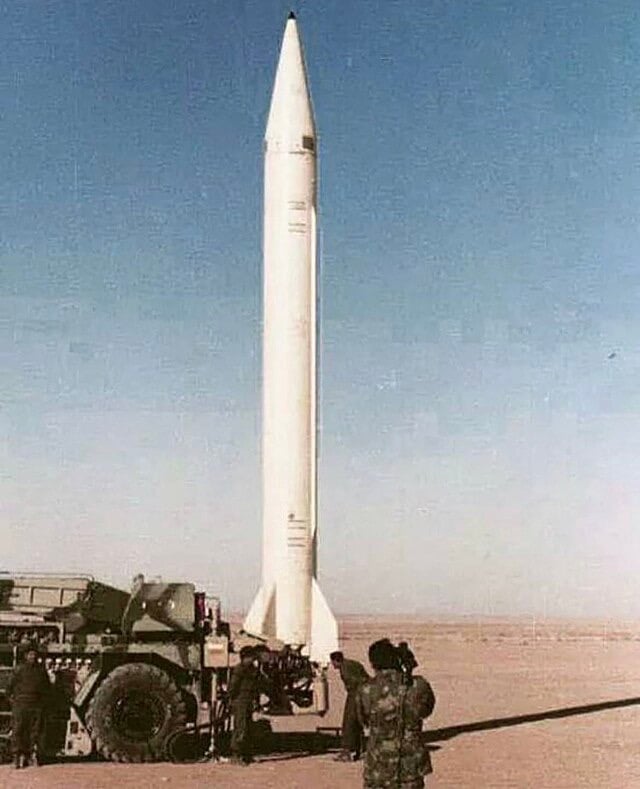
The Iranian ballistic missile strike on the joint UK-US military base at Diego Garcia has sent shockwaves through Western defence circles, with experts warning the attack has exposed a dramatic and previously unknown expansion in Tehran’s long-range strike capabilities — one that places major European capitals within potential range.
Two missiles were fired toward the Indian Ocean base on Friday night, in what is believed to be the first ever attack on the facility. One failed during flight, while a US warship intercepted the other. Whether that interception was fully successful has not been confirmed. The Government confirmed on Saturday that the strike occurred before Prime Minister Sir Keir Starmer authorised the US to use UK-based bombers to target Iranian missile sites threatening the Strait of Hormuz — a timeline that has prompted accusations from Conservative leader Kemi Badenoch of a “cover up” over why the public was not informed sooner.
The distance involved has alarmed analysts. Diego Garcia lies approximately 3,800 kilometres from Iran — nearly double the 2,000-kilometre range Tehran had previously claimed for its ballistic missiles. Foreign affairs analyst Nawaf Al-Thani said the strike meant a long-held assumption about Iranian capability “has just collapsed,” describing it as “a strategic leap” that moved the threat well beyond the Gulf region. “Paris comes into range. London moves much closer to the edge of vulnerability,” he wrote on social media. “If confirmed, Diego Garcia was not just a target. It was a message.”
Defence experts have suggested Iran may have deployed intermediate-range ballistic missiles or adapted its space launch vehicle programme for the strike. Justin Bronk, a senior research fellow at the Royal United Services Institute, noted that Iran’s Simorgh space launch vehicle could provide greater range “at the likely cost of terminal accuracy.” Retired Royal Navy Commodore Steve Prest added: “Ballistic missiles are space rockets. If you’ve got a space programme, you’ve got a ballistic missile programme.”
Paris sits approximately 4,198 kilometres from Tehran, while London lies around 4,435 kilometres away — placing both cities at or near the outer boundary of what Iran may now be capable of reaching, depending on payload and launch point.
General Sir Richard Barrons, former head of the UK’s Joint Forces Command, said Iran’s military strength had been “serially underestimated” and warned that Britain was now fully involved in the conflict regardless of its initial reluctance. “Iran and the UK have been at odds for a very long time,” he said. “The Iranian regime regards the UK as an enemy and so if you are seen to participate in some fashion with this US-Israeli offensive action then they are clearly going to respond and we should not be surprised.”
On the question of what comes next, General Barrons told BBC Radio 4’s Today programme that the US and Israel faced a stark choice — declaring victory and halting operations, or escalating further. “You can’t do much more with air power so you are beginning to talk about potentially using troops,” he said, pointing to a possible operation against Kharg Island as a more realistic option than any full-scale ground invasion of Iran.
The Diego Garcia strike came just seven days after Israeli forces hit Iran’s main space research centre in Tehran over concerns it was being used to develop satellite attack capabilities. The same night, US and Israeli forces struck the Natanz uranium enrichment facility and an ammunition airbase in Dezful. No radioactive leaks were reported. Israel has pledged that attacks on Iran will “significantly increase” in the days ahead, while the US has confirmed it has now struck more than 8,000 military targets since the conflict began.
