



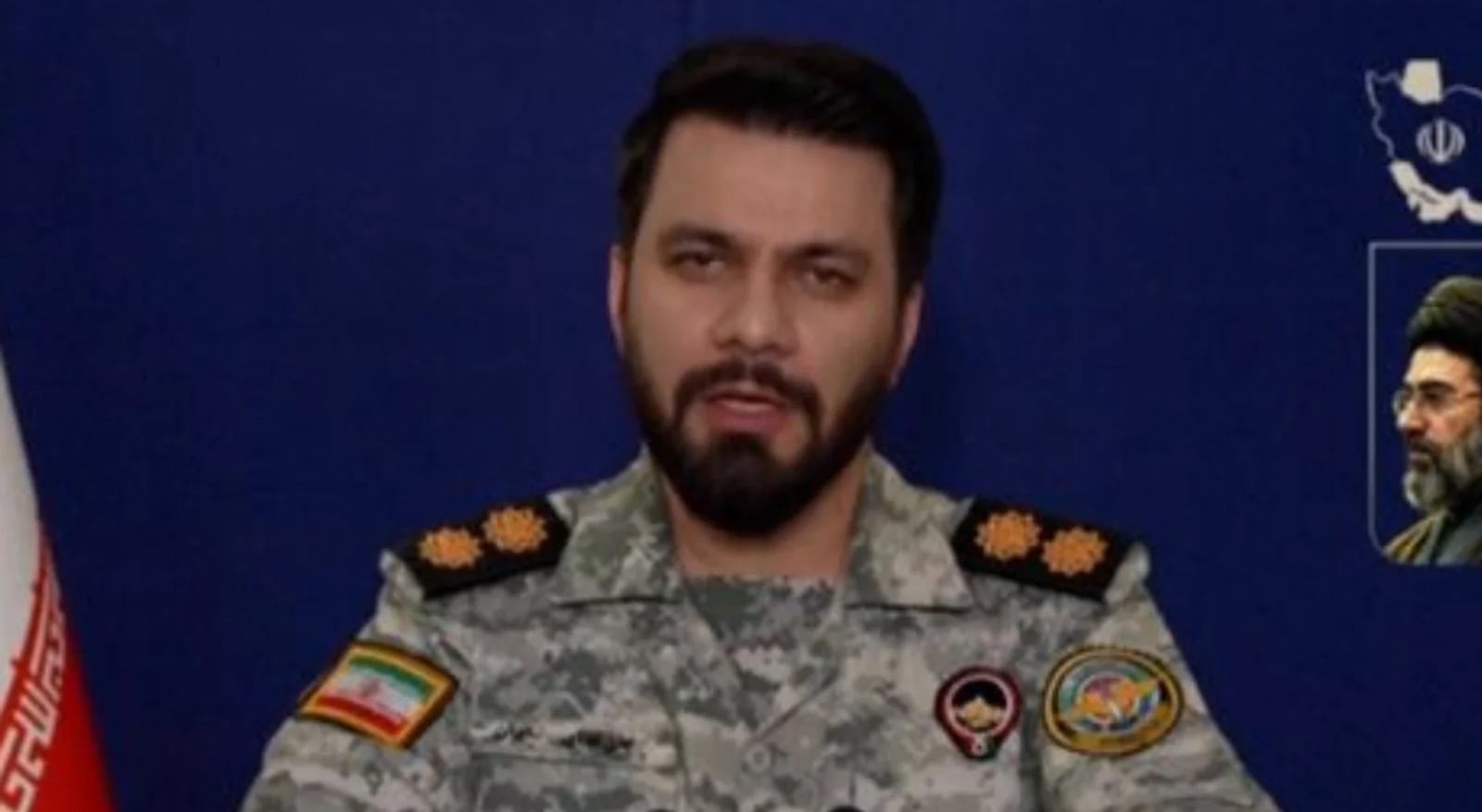
Iran’s military has flatly rejected Donald Trump’s claim that a peace deal is taking shape, with a senior spokesman accusing the United States of conducting negotiations with no genuine counterpart on the other side.
Trump told journalists on Tuesday that he was in contact with “the right people” within the Iranian regime and presented a 15-point framework for ending hostilities, insisting Tehran had already committed to abandoning its nuclear weapons programme. “They’re not going to have a nuclear weapon. That’s number one, two, and three. They’ve agreed to that,” he said.
Iranian military spokesman Ebrahim Zolfaghari responded with a pointed rebuttal, asking in a video address to the nation: “Has the level of your internal conflict reached the point where you are negotiating with yourselves?” He declared that “someone like us will never come to terms with someone like you. Not now, not ever,” and warned that American investments in the region and pre-conflict energy prices would not return until Washington acknowledged that regional stability depended on Iranian military power.
The contradictory signals from Tehran have deepened confusion about who, if anyone, is directing Iranian policy. Reports suggest the Revolutionary Guard Corps and elements of the military may now be operating independently of civilian political leadership. Iran’s President is said to have apologised to Gulf neighbours for strikes against them, while apparently being unable to prevent the armed forces from continuing attacks across the region.
Despite Iran’s public denials of any contact with Washington, Pakistani officials acting as intermediaries confirmed on Tuesday morning that Tehran had received the American peace proposal.
Trump claimed the talks had already yielded results, saying Iran had given the US “a very big present worth a tremendous amount of money” connected to oil and gas interests, without providing specifics. American and Israeli sources indicated he is seeking a one-month ceasefire to allow the 15-point framework to be finalised.
Fighting is continuing in the meantime, with US-led Operation Epic Fury and Israel’s Operation Roaring Lion pressing forward as Iranian forces strike at Israel, Jordan, Kuwait and Bahrain.
Iran’s foreign ministry has notified the UN Security Council and the International Maritime Organization that vessels deemed “non-hostile” may transit the Strait of Hormuz provided they coordinate with Iranian authorities and do not support military action against Iran. The message was distributed to 176 member states of the London-based shipping regulator. Shipping traffic through the strait, through which around a fifth of global oil and gas supplies normally pass, remains well below normal levels.
Britain is preparing to deploy a fleet of robotic minesweepers to help secure passage through the waterway as diplomatic and military efforts to resolve the crisis continue on multiple fronts.
