



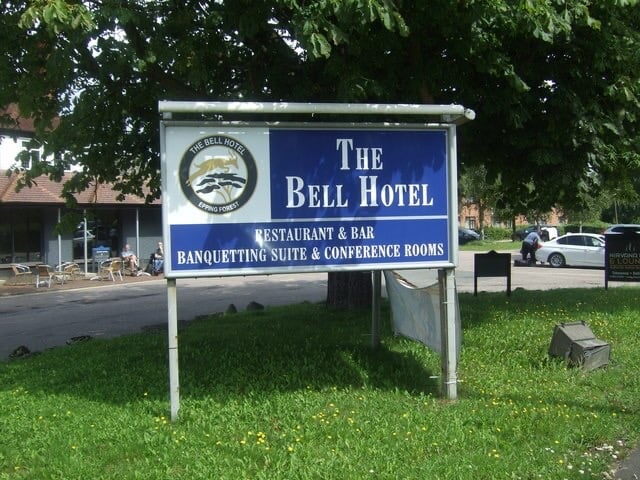
Asylum seekers will continue to be housed at a hotel in Epping, Essex, after two Court of Appeal judges rejected the local council’s attempt to overturn a previous ruling that had allowed the arrangement to stand.
Lady Justice Andrews and Lord Justice Holgate ruled on Friday morning that the council’s appeal was “unarguable,” bringing to a close a lengthy and costly legal battle that has drawn significant public attention since protests erupted at the site last summer.
The Conservative-led council had sought to challenge a November High Court decision in which Mr Justice Mould declined to grant a permanent injunction against Somani Hotels, the Bell Hotel’s owner. In that earlier ruling, the judge found the breach of planning rules to be “far from being flagrant” and concluded it was “not a case in which it is just and convenient for this court to grant an injunction.” The Court of Appeal judges backed that assessment, stating there was “no arguable basis” for criticising the judge’s reasoning.
The council had argued that hotels across the country were being used to house asylum seekers without adequate planning consideration — a concern it described as going “wider than just the Bell Hotel episode.” Those arguments were dismissed, with the court affirming that “the need to provide accommodation for persons present in this country, whether as asylum seekers or otherwise, is plainly capable of being a relevant planning consideration.”
Lawyers representing the Home Office, which had opposed the appeal alongside Somani Hotels, told the March hearing that the council was doing an “unjustified disservice to the judge’s comprehensive analysis of the law.”
The Bell Hotel has been used to house asylum seekers on three separate occasions, initially from May 2020 to March 2021, and again between October 2022 and April 2024. It was during its third period of use that the site became the focus of large-scale protests and counter-protests last summer, following the arrest of an asylum seeker housed there on charges of sexually assaulting a teenage girl in July.
The case drew further attention in October 2025 when Hadush Kebatu, an Ethiopian asylum seeker and convicted sex offender who had previously lived at the hotel, was mistakenly released from HMP Chelmsford. Kebatu had been sentenced to 12 months in prison for sexually assaulting a 14-year-old girl and a woman. Following a 48-hour manhunt, he was rearrested in Finsbury Park, north London, and subsequently deported to Ethiopia.
Epping Council is reported to have spent £566,000 pursuing the legal challenge. An earlier temporary injunction, which the council had successfully obtained last August, was itself overturned by the Court of Appeal on the grounds that it was “seriously flawed in principle.”
The ruling arrives against a broader national backdrop of pressure on asylum accommodation. Home Secretary Shabana Mahmood has announced plans to reduce reliance on hotels, including financial incentives of up to £40,000 to encourage failed asylum applicants to leave the country. As of December 2025, 103,426 people were in asylum accommodation in the UK, with roughly 30 per cent housed in hotels. Sir Keir Starmer has pledged to end the use of hotels for asylum seekers entirely by 2029.
