



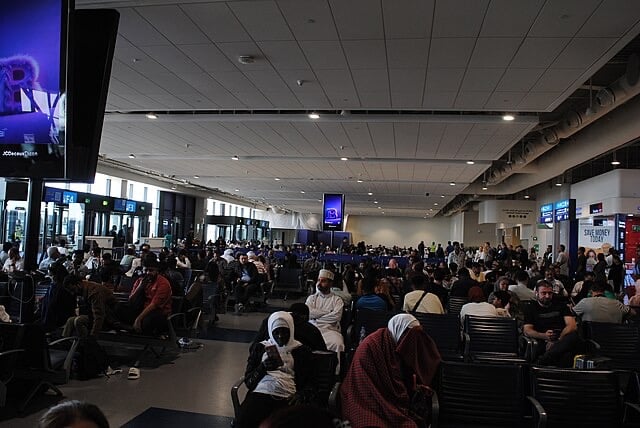
The marketing mythology that sustained Dubai’s extraordinary rise—positioning the emirate as Middle Eastern sanctuary immune to regional violence through sheer force of commercial ambition and strategic neutrality—collapsed measurably over recent weeks, with approximately 30,000 British residents now outside the United Arab Emirates as Iranian missile and drone campaigns shattered the foundational promise upon which the expatriate economy depends.
The scale of departure represents crisis not merely of security but of narrative: Dubai sold itself as geography-defying exception where Western professionals could harvest tax advantages and sunshine lifestyle whilst remaining insulated from the chaos engulfing surrounding territories. That proposition, always somewhat fantastical given the emirate’s location within one of history’s most volatile regions, now faces empirical refutation as between 10 and 15 percent of the pre-conflict British population of 240,000 has abandoned the city rather than endure continued exposure to attacks that have killed at least six people and forced tens of thousands into shelters.
Parents report classrooms depleted of pupils who have not returned following spring holidays, instead continuing education remotely from British locations their families had supposedly left permanently. One parent described “half of our son’s friends” no longer physically present, whilst another noted a “handful” of British children from a single year group now studying from homes in the UK—anecdotal evidence suggesting the official 30,000 departure figure may understate the true exodus when accounting for families maintaining formal UAE residence whilst sheltering abroad.
The psychological rupture extends beyond immediate security calculations into fundamental reassessment of life planning decisions that brought professionals to the Gulf. Residents who invested years establishing careers, purchasing property and enrolling children in expensive international schools now confront recognition that foundational assumptions about regional stability were dangerously optimistic. As one British resident of 16 years acknowledged, “the shine has definitely been taken off”—understated summary of confidence collapse that no amount of official reassurance about air defence intercept rates can fully repair.
Why This Exodus Transcends Temporary Evacuation Dynamics
The departure pattern differs fundamentally from conventional emergency evacuations that see residents flee immediate danger before returning once threats subside. Multiple indicators suggest substantial portion of those who left do not intend to return, transforming what Dubai authorities hope to characterise as temporary displacement into permanent demographic adjustment with cascading economic implications.
Families have enrolled children in British private schools mid-academic-year—a commitment involving substantial fees and social disruption that parents would not undertake if planning imminent return to UAE institutions. The willingness to absorb these costs and complications indicates that affected families have fundamentally revised their risk assessments in ways that extend beyond current military campaign’s duration.
Education sector sources report that new student pipeline has “stalled” as prospective expatriate families reassess relocation plans, whilst withdrawals accelerate among current residents. Industry representatives acknowledge privately that some departed families prove “unlikely to return”—careful phrasing that nonetheless signals recognition that damage extends beyond immediate crisis management into long-term demand erosion.
The celebrity departures that tabloids eagerly documented—former England footballer Rio Ferdinand and wife Kate retreating to Portuguese residence, reality television personality Luisa Zissman complaining of entering her “refugee era”—serve as visible markers of broader trend affecting thousands of less prominent professionals whose departures generate no headlines but collectively reshape Dubai’s demographic composition.
Nigel Lea, a Dubai-based security consultant, characterised the phenomenon carefully: “Many Brits have chosen to relocate temporarily to alleviate anxiety and share childcare and schooling with a home country support network.” The formulation emphasises temporary nature whilst acknowledging drivers—anxiety, need for support networks—that resist easy resolution through improved air defence statistics or official reassurances.
The UAE government’s position that most incoming missiles and drones face interception from defensive systems supported by British and French fighter jets provides factual accuracy about technical capability whilst missing the psychological reality that even successful intercepts validate the threat. Residents experience “near constant alerts and visible strikes” regardless of whether munitions reach intended targets—a sustained assault on the psychological contract that promised insulation from regional violence.
What Daily Life Looks Like in a City Under Siege
Explosions have struck areas including Dubai’s airport vicinity—an attack geography particularly calculated to undermine confidence given aviation’s centrality to the emirate’s connectivity and economic model. Flight disruptions compound direct security concerns by threatening Dubai’s positioning as regional business hub where seamless global connections enable the professional services and financial sector activity that justify its existence.
Hotels and industrial zones have sustained strikes targeting what Iran presumably considers dual-use or economic infrastructure, though international humanitarian law provides minimal distinction that would render such targeting lawful. The effect on civilian psychology proves identical regardless of legal categorisation: visible evidence that nowhere in the emirate stands truly safe from incoming munitions.
Schools face impossible positioning between regulatory caution and commercial pressure. Operators have “pushed to resume face-to-face teaching for pupils sitting key exams”—acknowledging the educational damage from extended remote learning—whilst regulators signal that “it is highly unlikely classrooms will reopen soon given security risks.” The standoff leaves families suspended between inadequate remote instruction and unacceptable physical risk, with predictable result that those possessing resources and alternative options exercise them through departure.
The broader expatriate workforce confronts parallel uncertainty. Businesses operate under conditions where routine commercial activity coexists uneasily with emergency protocols, where conference calls might be interrupted by shelter-in-place alerts, where daily commutes require calculating blast radius risks. The accumulation of such calculations, repeated across days and weeks, generates exhaustion and risk reassessment even among those initially committed to remaining.
New construction projects including “British-branded schools” officially proceed according to development timelines, yet private investor conversations acknowledge doubt about filling capacity if expatriate flows diminish. The optimistic scenario sees current departures as temporary anomaly followed by rapid return once conflict concludes; the pessimistic assessment suggests fundamental shift in Dubai’s risk profile that permanently reduces its attractiveness relative to genuinely stable alternatives.
The Structural Consequences for an Economy Built on Foreign Confidence
Dubai’s extraordinary growth trajectory depended absolutely on continuous foreign worker influx, with expatriates comprising “the vast majority of the population” in demographic composition without parallel among major global cities. This model—importing nearly all professional and manual labour whilst maintaining minimal indigenous workforce—created economic dynamism at cost of permanent vulnerability to confidence shocks that might trigger departure cascades.
The current exodus, whilst substantial in absolute terms, affects roughly one-eighth of British population—a proportion that would devastate most cities but which Dubai’s demographic structure can theoretically absorb if departures remain contained and reverse relatively quickly. The crucial question concerns whether current outflow represents peak or initial wave of larger adjustment as families already contemplating return to UK for educational, family or career reasons accelerate timelines in response to changed security environment.
Official insistence that the UAE will “come back very strong” once conflict ends reflects confidence in the emirate’s fundamental advantages—tax regime, infrastructure, geographic positioning—that have historically overcome periodic crises. Yet the current threat differs from financial crashes or pandemic disruptions that affected all global cities roughly equally. Iranian missile campaigns specifically target Dubai’s claimed exemption from Middle Eastern instability, striking at the core marketing proposition rather than creating shared hardship that reinforces commitment to weather difficulties collectively.
For years, the emirate “sold itself as a place insulated from the chaos of the Middle East”—a claim that always required willing suspension of geographical reality and selective historical memory about regional conflicts that periodically threatened Gulf stability. The current crisis exposes that insulation as aspirational rather than guaranteed, forcing residents to confront the gap between marketing narrative and geopolitical fact.
Whether Dubai recovers its appeal or faces sustained demographic adjustment depends partly on conflict duration and intensity, but also on less tangible factors around restored confidence. Even if strikes cease tomorrow, families now know experientially that Iranian munitions can reach Dubai, that air defences provide imperfect protection, that regional violence can penetrate the emirate’s carefully constructed image of sanctuary. That knowledge, once acquired through lived experience rather than abstract awareness, proves difficult to dislodge through subsequent periods of calm.
The test facing Dubai’s leadership extends beyond immediate crisis management toward fundamental question: can a city built on promise of stability maintain that promise whilst located within range of adversary willing to strike civilian targets during regional conflicts? The 30,000 British residents now outside the UAE have answered that question through departure. Whether they prove temporary refugees or permanent emigrants will determine whether Dubai’s extraordinary experiment in manufactured exception can survive contact with geopolitical reality.
