



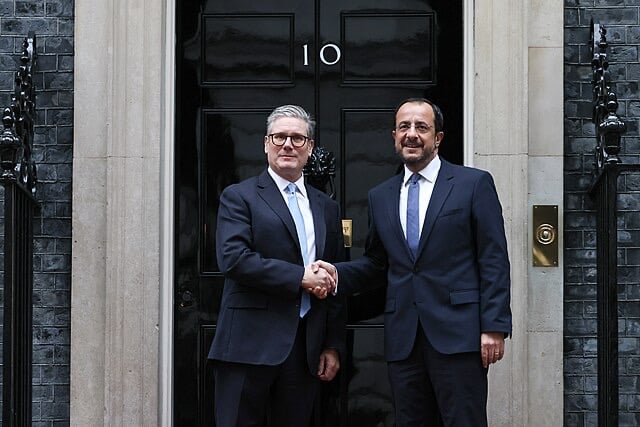
The President of Cyprus has signalled he intends to raise the future of British military bases on the island directly with the UK government, following an Iranian drone strike on RAF Akrotiri that has intensified domestic pressure over Cyprus’s role in the Middle East conflict.
Speaking at the European Council summit in Brussels this week, President Nikos Christodoulides described the British bases as “a colonial consequence” and confirmed that the situation in the Middle East had prompted him to seek what he called “an open and frank discussion with the British government.” He cited the presence of more than 10,000 Cypriot citizens living within the boundaries of the British bases as a key factor in his decision to raise the matter formally.
When asked directly whether he wanted the bases removed, Christodoulides declined to state his position publicly, saying only that Cyprus had “a clear approach with regard to the future of the British bases” and that he would not “negotiate in public.”
The Iranian drone strike on RAF Akrotiri on Sunday struck a hangar typically used to house US surveillance aircraft, bringing the conflict directly to British sovereign territory on the island and sharply raising the stakes of the debate within Cyprus. The attack has galvanised opposition voices, with the main opposition party Akel calling outright for the bases to be closed. Party leader Stefanos Stefanou told local media that Cyprus “is not and does not want to become a war base.”
The issue was also raised at Westminster, where Liberal Democrat MP Al Pinkerton pressed Defence Secretary John Healey for an update on the UK-Cyprus defence relationship following his visit to the island earlier this month. Healey sought to reassure the House, stating that the sovereign base “isn’t in question” and that the Cypriot National Guard had reaffirmed during his visit that “our relationship is closer now than ever before.”
The competing signals from Nicosia and London suggest the two governments may be heading toward a more formal exchange on the long-term future of the sovereign base areas, even as Britain insists the relationship remains solid. How those discussions unfold is likely to be shaped significantly by how the wider conflict in the Middle East develops in the weeks ahead.
