



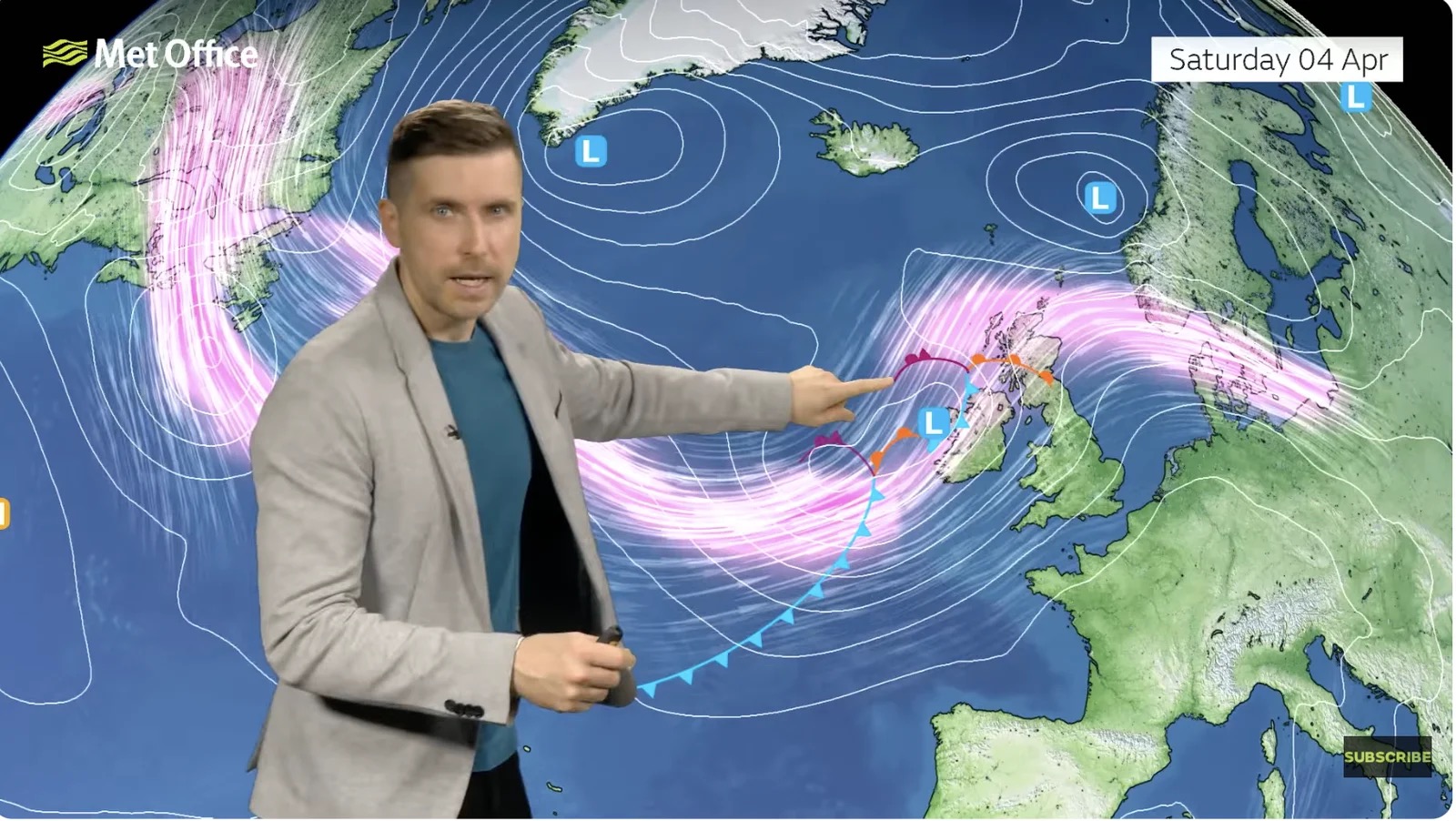
Meteorologists are expressing heightened concern over Storm Dave’s approach this weekend, with the system potentially becoming the most powerful April storm Britain has experienced as an unusually vigorous jet stream propels multiple low-pressure systems across the Atlantic.
The Met Office confirmed warnings for damaging winds are active across northern Britain ahead of Saturday afternoon’s expected impact, with forecasters suggesting the depression could challenge the UK’s April pressure record of approximately 961 millibars.
“This looks like a very deep area of low pressure, particularly for the time of year,” stated Met Office meteorologist Alex Burkill, adding that Saturday would bring “very strong winds” with conditions appearing “particularly unsettled and perhaps stormy towards some parts of the northwest as we go through into Sunday.”
The storm’s development involves explosive cyclogenesis—the rapid intensification process responsible for Britain’s most devastating weather events—occurring as the system crosses the jet stream whilst approaching UK shores.
Mr Burkill explained: “There is a feature that arrives on Saturday that we are more concerned about. As it comes towards us, it crosses the jet and lands on the left exit side, and that movement leads to it deepening rapidly.”
Scottish coastal regions face potential 90mph gusts whilst inland areas could experience 70mph winds, with southeastern England escaping relatively unscathed compared to Scotland and northern England bearing the brunt.
Jim Dale, meteorologist for British Weather Services and co-author of ‘Surviving Extreme Weather’, warned: “This storm has the potential to cause some major disruption over the Easter weekend. With the strong winds, there will be heavy rain, hail and the risk of thunder.”
The jet stream’s unusual strength stems from atmospheric battles between cold and warm air masses over the United States, creating a conveyor belt effect transporting a trio of storms eastward over coming days, though Saturday’s system appears most disruptive.
Complicating forecasting efforts, the depression possesses an elongated shape making precise predictions regarding peak wind locations and timing more challenging. “That makes it more difficult to be precise about where and when we are going to see the strongest winds,” Mr Burkill acknowledged.
Northern regions face additional wintry threats, with Good Friday expected to deliver snow showers as colder air masses infiltrate. “Colder air is digging in on Good Friday, and that means some showers will quite regularly fall as sleet and snow particularly over parts of Scotland,” the meteorologist stated.
Following Dave’s passage, another system waits to strike on Monday, extending the four-day storm washout through the Easter holiday period.
Saturday morning will greet most locations with chilly conditions alongside Scottish wintry showers before the main storm arrives afternoon.
