



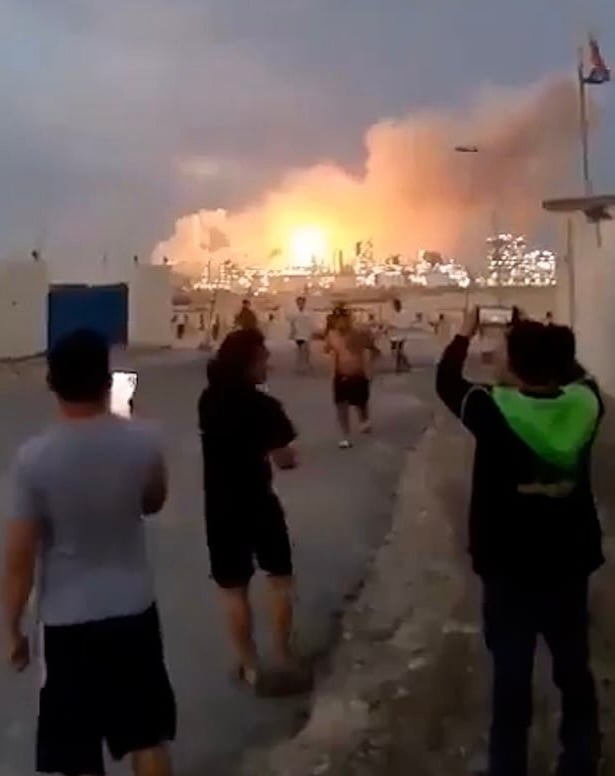
A major oil refinery in Bahrain has been struck in an Iranian drone attack, triggering large fires and sending columns of smoke into the sky above the Gulf state, as Iran escalates its campaign against energy infrastructure across the region in retaliation for the US-Israeli strikes that killed its Supreme Leader.
Bahrain’s government confirmed that a facility in the Maameer area had been targeted, with the attack damaging a unit of BAPCO Energies’ refinery — a site with a maximum production capacity of 267,000 barrels of oil per day and storage capacity for up to 14 million barrels. Footage from the scene showed at least two large plumes of smoke rising from the site, with a significant fire visible at the base of one. Authorities said the blaze was subsequently brought under control.
The strike came on a day of intensifying Iranian military activity across the Gulf. Bahrain’s defence ministry said its forces intercepted 75 Iranian ballistic missiles, destroying 65 while 10 landed inside its territory. A further 124 drones were also intercepted, with 88 shot down and 36 reaching Bahraini soil. Sirens were reported across the country as the attacks unfolded.
The assault on Bahrain’s energy infrastructure formed part of a wider Iranian offensive now targeting all six Gulf Cooperation Council member states — Bahrain, Saudi Arabia, Qatar, the UAE, Kuwait and Oman. Foreign ministers from GCC nations and the European Union held emergency video talks, issuing a joint statement that “strongly condemned the unjustifiable Iranian attacks against the GCC countries which threaten regional and global security,” calling on Tehran to “cease immediately its attacks.” The statement also affirmed that GCC states retained “the right to take all necessary measures” to defend themselves.
The crisis has spilled into Gulf waters, with nine vessels having come under attack since hostilities broke out on Saturday. A Bahamas-flagged crude oil tanker was struck near Iraq’s Khor al Zubair port by an Iranian remote-controlled explosive boat, while a second tanker anchored off Kuwait was taking on water and leaking oil following an explosion. Iranian drones also entered Azerbaijani territory, injuring four people and threatening to extend the conflict to further oil-producing nations.
Shipping disruption has reached a critical scale. Around 200 vessels, including oil tankers, liquefied natural gas carriers and cargo ships, remained at anchor in open Gulf waters, with hundreds more unable to pass through the Strait of Hormuz — a waterway through which approximately a fifth of the world’s oil and LNG supply flows. Iraq cut its oil production by nearly 1.5 million barrels per day after running out of storage capacity, while refineries in Kuwait and Bahrain reduced output or shut down entirely. BP evacuated foreign staff from Iraq’s Rumaila oil field after unidentified drones landed within the site.
President Donald Trump offered US Navy escorts and shipping insurance in a bid to restore vessel movements and ease rising energy prices. Insurance market Lloyd’s of London confirmed it was in discussions with the US government on a plan to facilitate this.
EU foreign policy chief Kaja Kallas, who chaired the emergency ministerial talks, warned that European supplies of drone interception equipment were constrained by simultaneous demand from Ukraine. “Everybody has the need for air defence. So there is really a problem with production,” she said, adding that Europe needed to “speed up” manufacturing capacity. “I’m worried that the capabilities are limited,” she added.
The GCC and EU ministers jointly reaffirmed their commitment to diplomacy and pledged joint efforts to prevent Iran from acquiring a nuclear weapon and to press Tehran to halt the production and proliferation of ballistic missiles and drones.
