



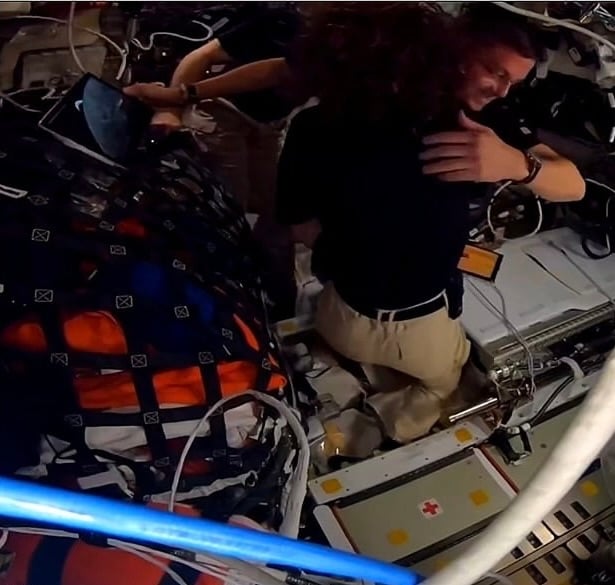
Christina Koch’s philosophical epiphany arrived not during the carefully choreographed moments of peak drama, but in a fleeting instant whilst photographing the Moon’s scarred terrain through Orion’s reinforced windows. “Something just drew me in suddenly to the lunar landscape, and it became real,” the NASA astronaut recalled, describing how the celestial body transformed from abstract poster in Earth’s sky to tangible world during humanity’s deepest venture into space in over half a century.
That moment of recognition—lasting mere seconds before rational thought reasserted itself—encapsulates the significance of Monday’s achievement, when Koch and her three crewmates became the first humans since 1972 to witness the Moon’s perpetually hidden hemisphere with unmediated vision. The four-person Artemis II team has now begun their four-day return journey to Friday’s anticipated Pacific splashdown, having established a new benchmark for human distance from Earth at 252,756 miles during their sweeping lunar flyby.
The mission’s headline statistics—surpassing Apollo 13’s 1970 distance record by over 4,000 miles, approaching within 4,070 miles of the lunar surface, enduring a planned 40-minute communications blackout—provide quantifiable measures of accomplishment. Yet the crew’s unscripted observations during their six-hour transit across the Moon’s far side offer insights into how direct human perception continues to generate value that automated systems struggle to replicate.
What Six Hours Observing an Alien Landscape Revealed
The Moon’s far side presents geological characteristics strikingly different from the familiar near hemisphere, featuring heavily cratered terrain, thicker crustal composition, and notably fewer dark volcanic plains. NASA astronauts Reid Wiseman, Victor Glover and Koch, alongside Canadian Space Agency astronaut Jeremy Hansen, reported visual phenomena ranging from geometric patterns and features they termed “squiggles” to unexpected pigmentation including green and brown hues across supposedly monochromatic grey regolith.
Glover, tasked with narrating observations to Mission Control before the inevitable signal loss, described “an island of terrain completely surrounded by darkness” and a formation resembling “a snowman” created by adjacent impact craters to the north. His accounts frequently employed terrestrial analogies to convey unfamiliar topography: one impact basin’s contrasting rings appeared “as if the edges are starting to dry up,” evoking wet spots that desiccate first at their periphery.
Koch identified fresh impact craters that “stand out like tiny holes in a lampshade,” their bright ejecta material creating pinpricks of illumination against darker surroundings. The comparison suggests recent bombardment has left visible scars despite the Moon’s four-billion-year geological history—a reminder that cosmic violence continues shaping worlds throughout the solar system.
The feature commanding Glover’s sustained attention proved to be the lunar terminator, the shifting boundary where sunlight yields to shadow. He described returning repeatedly to study this transitional zone, where “bright patches of sunlight break through deep, pitch-black valleys that appear almost bottomless from orbit.” The dramatic interplay of illumination and void along this moving line prompted extensive sketching and reflection during his observation rotation.
Hansen’s specific observations remain less documented in available transcripts, though all four crew members contributed to the comprehensive photographic and visual survey conducted during the flyby—data that will undergo detailed analysis once the spacecraft returns to Earth.
Why Human Observers Still Matter in an Age of Automation
The communication blackout commencing at 6.43pm Eastern Time represented one of the mission’s most psychologically demanding phases. As Orion slipped behind the Moon, radio signals between spacecraft and terrestrial antennas ceased abruptly, leaving the crew reliant entirely on pre-programmed flight systems without real-time guidance from Houston’s Mission Control.
“We will see you on the other side,” Glover transmitted moments before signal loss, having just referenced biblical teachings about loving one’s neighbour—an invocation of spiritual reflection before entering isolation. The 40-minute void, whilst anticipated and routine for lunar missions, underscores the existential reality of deep space travel: humans venturing beyond low Earth orbit move temporarily beyond all direct contact with civilisation, dependent upon technology and training to navigate autonomously.
Capsule communicator Jenni Gibbons marked signal restoration with symbolic gesture, informing the crew that flight controllers had physically rotated their mission patches—originally displaying Earth in foreground with Moon distant, now reversed to show Moon prominent and Earth receding. “We are Earthbound and ready to bring you home,” Gibbons transmitted, acknowledging the crew’s passage through the mission’s deepest excursion and commencement of return trajectory.
NASA Administrator Jared Isaacman framed the achievement within broader narratives about American technological capability. “Before they left, they said they hoped this mission would be forgotten, but it will be remembered as the moment people started to believe that America can once again do the near-impossible and change the world,” Isaacman stated, whilst cautioning that “the mission isn’t over until they’re under safe parachutes, splashing down into the Pacific.”
The distance record itself—surpassing Apollo 13’s emergency trajectory by 4,101 miles—carries particular resonance given that mission’s status as “successful failure.” Whereas Jim Lovell, Fred Haise and Jack Swigert achieved their record whilst battling catastrophic systems failure that threatened their survival, the Artemis II crew reached greater remove from Earth during nominal operations, suggesting improvements in spacecraft capability and mission planning across five decades.
Koch’s philosophical conclusion distilled the mission’s deeper significance beyond technical milestones. “The truth is, the Moon really is its own body in the universe, it’s not just a poster in the sky,” she observed. “It is a real place. And when we have that perspective, and we compare it to our home, Earth, it just reminds us how much we have in common. Everything we need, Earth provides. And that is somewhat of a miracle, and one that you can’t truly know until you’ve had the perspective of the other.”
That recognition—Earth’s uniqueness becoming visible only through contrast with barren alternatives—echoes observations from Apollo-era astronauts whose “Earthrise” photographs helped catalyse environmental consciousness. The Artemis generation carries forward this tradition of perspective transformation, though whether their insights generate comparable cultural impact remains contingent upon factors extending well beyond the mission’s technical execution.
The crew faces one additional observational opportunity before splashdown: a solar eclipse visible from lunar orbit beginning at 8.35pm Eastern Time, lasting approximately one hour. From their unique vantage, the astronauts will witness Earth’s shadow sweeping across the lunar surface—the inverse of the total solar eclipses billions have observed from Earth’s surface, creating symmetry in cosmic observation that human eyes alone will record.
