



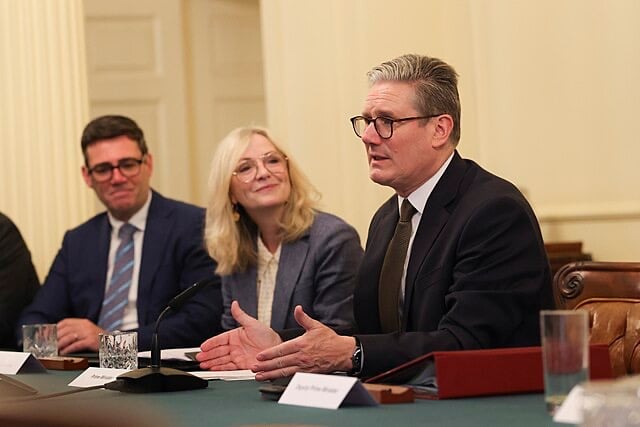
Andy Burnham has declined to rule out a return to the House of Commons, saying his plan to “head south” is only “currently on hold” — as the fallout from Labour’s catastrophic by-election defeat continues to intensify pressure on Sir Keir Starmer’s leadership.
The Greater Manchester mayor, widely regarded as a potential future Labour leader, made the remarks at a Centre for Cities event in central London on Wednesday, where he also delivered a stark warning about the state of Westminster politics following last week’s result in Gorton and Denton.
Labour suffered a heavy defeat in the Greater Manchester constituency, being pushed into third place behind both the Green Party — who won the seat — and Reform UK. The result in what had been considered a Labour stronghold was described by Burnham as evidence of “the full depth of the chasm between people and Westminster politics.”
Burnham referenced his co-authored book with Liverpool City Region mayor Steve Rotheram — titled Head North and focused on devolution across England — before hinting at future plans. “All I can say today is that the sequel Head South is currently on hold,” he told the audience, stopping short of a firm commitment in either direction.
When pressed by reporters on why he would contemplate returning to Westminster given his stated frustrations with the institution, Burnham pointed to what he described as a structural bias against the North of England embedded in the political system. “I don’t think Greater Manchester’s full ambitions are achievable with the political system staying as it is,” he said. “There is, in my view, a bias against the North of England. I saw it with my own eyes in Westminster, and not just an emotional bias, it’s hardwired, it’s in the green book.”
His plan to stand in the Gorton and Denton by-election had previously been blocked by Sir Keir, a decision that now looks particularly damaging given the scale of Labour’s subsequent defeat.
The remarks came alongside a new Ipsos poll showing Labour support among Scottish voters had risen four percentage points, placing the party on 20 per cent in Holyrood constituency voting intention — still behind the SNP on 36 per cent but ahead of Reform on 16 per cent. The survey was conducted after Scottish Labour leader Anas Sarwar publicly called for Sir Keir to resign, describing him as a “decent man” who had made “too many mistakes.”
Burnham described polling by More in Common — which found a majority of people did not believe the cost-of-living crisis would ever end — as “code red for Westminster politics”, adding: “This is getting extremely dangerous, and change in our political system and culture is desperately needed.”
Whether Burnham moves to formalise any return to Westminster will depend in part on how the political landscape around Labour’s leadership evolves in the coming months.
