



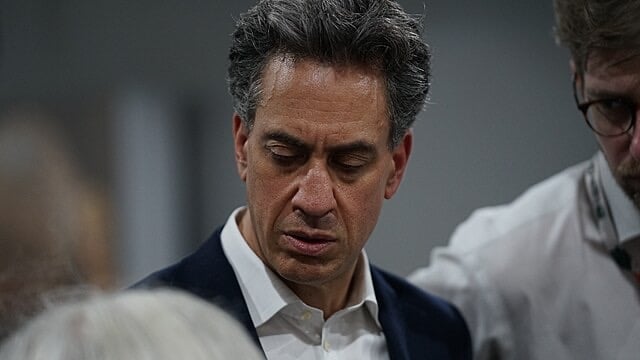
A prominent Oxford economist has challenged Energy Secretary Ed Miliband to abandon what he describes as simplistic messaging on natural gas and adopt a more evidence-based approach to energy policy, as the war in Iran intensifies pressure on the Government over North Sea production.
Sir Dieter Helm, professor of economic policy at Oxford University, argued that gas will remain a central part of Britain’s energy mix for the foreseeable future regardless of political ambitions, and that producing it domestically in the North Sea would bring clear advantages for both energy security and the broader economy.
“We should stop trotting out myths about gas, gas markets, home grown and all that stuff and start to take seriously what confronts our economy,” Sir Dieter said in his podcast, Helm Talks. “Gas is going to be there whether we like it or not. Let’s do it responsibly, let’s do it securely and let’s do it in an environmentally benign way.”
He identified three claims he described as myths being repeatedly advanced by ministers: that the UK is moving away from gas dependence, that it uses its own domestically produced gas, and that the price of homegrown gas must track international market prices. He argued all three were incorrect, pointing out that Britain remains 35 per cent dependent on gas for its energy needs — a figure that shows no sign of falling significantly — and that the country is currently importing North Sea gas from Norway as well as liquefied natural gas from further afield, which carries a higher carbon footprint than domestic production.
“So we are not using our own gas and as a result we are less secure than otherwise would be the case,” he said.
On the question of pricing, Sir Dieter challenged the Government’s assertion that new North Sea licences could not reduce bills because gas is sold on international markets. He pointed to the period when British Gas operated as sole buyer, when long-term fixed-price contracts were agreed, and suggested similar arrangements could be structured today. “Since the Government controls the offshore licences, there is nothing to prevent it from entering new fixed-price long-term contracts going forward,” he said.
The debate has sharpened since the outbreak of the Iran conflict drove global energy prices sharply higher. Conservative leader Kemi Badenoch raised the issue directly with Sir Keir Starmer at Prime Minister’s Questions, describing the ban on new North Sea drilling as “reckless” before the election and “catastrophic” during a global energy crisis. Starmer told MPs that oil and gas would remain part of the energy mix “for many years to come,” while maintaining that the long-term answer lay in renewables.
Miliband’s department has maintained that the only route to shielding UK consumers from future price shocks is to reduce dependence on fossil fuel markets entirely. A Government spokesperson said issuing new exploration licences “cannot give us energy security and will not take a penny off bills,” arguing that oil and gas sold on international markets makes Britain a “price taker” regardless of where it is produced.
Sir Dieter acknowledged the current price spike was linked to the Iran conflict rather than representing a long-term trend, drawing a parallel with the period following Russia’s invasion of Ukraine in 2022, when prices eventually fell back. He warned, however, that UK industrial energy prices had remained stubbornly high even as renewables capacity expanded, undermining the argument that wind and solar investment alone was bringing costs down relative to European and global comparators.
