



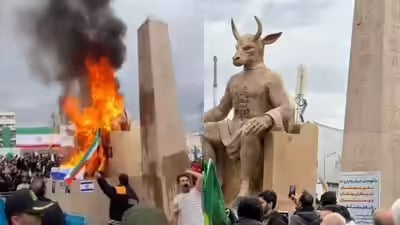
Iranian demonstrators burned a large sculpture of the ancient deity Baal adorned with a Star of David whilst chanting “Death to Israel” and “Death to America” during state-organized rallies in Tehran on February 11, 2026.
The effigy burning took place at Azadi Square and other central Tehran locations as part of mass demonstrations marking the 47th anniversary of the 1979 Islamic Revolution. The sculpture depicted Baal with horns and was cast as a “satanic figure,” with protesters affixing both a Star of David and a photograph of US President Donald Trump to the effigy.
Crowds torched the Baal sculpture alongside American and Israeli flags and mannequins representing Trump and Israeli Prime Minister Benjamin Netanyahu. The symbolic display served as a state-organized show of defiance against the United States and Israel during a period of intense regional and domestic tension.
By affixing the Star of David to the Baal effigy, demonstrators attempted to delegitimize the state of Israel by portraying it as a “pagan” or “satanic” entity rather than a truly religious one. In contemporary Iranian political discourse, the use of Baal is intended to equate the US and Israel with evil, elite corruption, and “satanic” influence.
The rallies featured additional symbolic acts including displays of ballistic missiles, wreckage from downed drones, and symbolic coffins bearing the names of senior US military officials. High-ranking officials including President Masoud Pezeshkian, Foreign Minister Abbas Araghchi, and Quds Force commander Ismail Qaani participated in the marches to project national unity.
Baal originates from Northwest Semitic languages meaning “lord,” “master,” or “husband.” Historically, the deity was worshipped by Canaanites and Phoenicians as the god of rain, thunder, and agriculture. Ancient tablets from Ugarit describe epic battles against Yam and Mot to secure his kingship over the gods.
In Judaism, Christianity, and Islam, Baal is cast as the ultimate “false god” and symbol of idolatry. The Hebrew Bible depicts Baal as the primary rival to Yahweh, with the prophet Elijah challenging 450 prophets of Baal on Mount Carmel in the most famous Biblical conflict.
Christianity associated the name with demonology over time, with the term Beelzebub representing a derogatory corruption of Baal-Zebul and used in the New Testament to refer to Satan. The Quran mentions Baal in the story of the prophet Ilyas, who rebuked his people for worshipping the idol instead of Allah.
The connection between Jeffrey Epstein and the Baal symbolism at the rally stems from a conspiracy theory circulating in Iranian state-aligned media and online Western circles. Social media posts and certain news reports claimed Jeffrey Epstein had a bank account or wire transfer field named “baal.name” based on purported documents from the Epstein Files.
Pro-government Iranian demonstrators and online conspiracy theorists interpreted this as proof of Epstein’s involvement in occult “Satanic” rituals and elite child sacrifice, using “Baal” as code for these activities. Modern narratives sometimes link the name Baal to elite corruption, secret societies, and alleged ritualistic crimes.
The 2026 anniversary occurred under significant pressure for Iranian leadership. The government had recently conducted a lethal crackdown on nationwide anti-government protests sparked in late 2025 by economic hardship, whilst simultaneously navigating fledgling nuclear talks between the US and Iran.
The demonstrations coincided with high-level meetings between President Trump and Prime Minister Netanyahu in Washington, underscoring the complex geopolitical dynamics facing Tehran. The Iranian government’s use of religious and conspiratorial symbolism to mobilize support equated political enemies with ancient spiritual corruption whilst projecting strength during a vulnerable period.
The symbolic use of an ancient deity associated with idolatry across Abrahamic religions, combined with modern conspiracy narratives and antisemitic imagery, represented the Iranian authorities’ strategy to blend religious symbolism with contemporary political messaging during the state-organized rally.
